Public Member Functions |
| | DtIfCreateVrfObject () |
| | default constructor
|
| virtual | ~DtIfCreateVrfObject () |
| | destructor
|
| | DtIfCreateVrfObject (const DtIfCreateVrfObject &orig) |
| | copy constructor
|
| DtIfCreateVrfObject & | operator= (const DtIfCreateVrfObject &orig) |
| | assignment operator
|
| virtual DtSimInterfaceContent * | clone () const |
| | Returns a newly created instance of a DtIfCreateVrfObject.
|
| virtual int | type () const |
| | Returns the string type of message, DtCreateVrfObjectMessageType (defined in msgTypes.h).
|
| virtual unsigned long | requestId () const |
| | Set/get the request Id for the message.
|
| virtual void | setRequestId (unsigned long requestId) |
| virtual void | setVrfProcessAddress (const DtSimulationAddress &address) |
| | Set/get the address of the VR-Forces process that we want to create the new vrf object.
|
| virtual const DtSimulationAddress & | vrfProcessAddress () const |
| virtual void | setObjectName (const DtString &objectName) |
| | Set/get the object name of the vrf object to create.
|
| virtual const DtString & | objectName () const |
| virtual void | setObjectType (const DtObjectType &objectType) |
| | Set/get the object type of the vrf object to create.
|
| virtual const DtObjectType & | objectType () const |
| virtual void | setForceType (const DtForceType forceType) |
| | Set/get the force type of the vrf object to create.
|
| virtual DtForceType | forceType () const |
| virtual void | setObjectLabel (const DtString &objectLabel) |
| | Set/get the object label of the vrf object to create.
|
| virtual const DtString & | objectLabel () const |
| virtual void | setExtendedLabels (const std::map< int, DtString > &extendedLabels) |
| | Set/get the object label of the vrf object to create.
|
virtual const std::map< int,
DtString > & | extendedLabels () const |
| virtual void | setOverlayParent (const DtString &overlayParent) |
| | Sets the overlay parent of this object.
|
| virtual const DtString & | overlayParent () const |
| virtual const DtVector & | position () const |
| | In geocentric coordinates.
|
| virtual void | setPosition (const DtVector &position) |
| virtual DtReal | heading () const |
| | 0 is north, clockwise, in radians.
|
| virtual void | setHeading (DtReal heading) |
virtual const std::vector
< DtVector > & | vertexList () const |
| | This is where the actually object geometry goes position() is just an alias for the first vertex.
|
| virtual const DtList & | vertices () const |
| | Backwards compatible access to vertexList.
|
| virtual void | addVertex (const DtVector &vertex) |
| | Add a vertex to the end of the vertex list.
|
| virtual bool | projection () const |
| | Do the Z elements of the vectors in the vertex list have meaning?
|
| virtual void | setProjection (bool projection) |
| virtual bool | closedFigure () const |
| | Does the last vertex connect back to the first? Obviously, this is undefined for a single vertex (but I suppose an argument could be made for that being a closed figure...)
|
| virtual void | setClosedFigure (bool closedFigure) |
| virtual const DtAppearance & | appearance () |
| | Appearance.
|
| virtual void | setAppearance (const DtAppearance &appearance) |
| virtual bool | createSubObjects () const |
| | Create SubObjects.
|
| virtual void | setCreateSubObjects (bool createSubObjects) |
| virtual bool | addToOrganization () const |
| | If True (the default) and the object being created is an orgainzed object type (as specified by the is-organized flag in the OPD file), the newly created object will be added to the organization manager directly below the force level aggregate of this object's force.
|
| virtual void | setAddToOrganization (bool addToOrg) |
| virtual bool | clampToGround () const |
| | If True (the default) the object will be created and placed on the nearest polygon.
|
| virtual void | setClampToGround (bool clamp) |
| virtual DtAggregateState | initialAggregateState () const |
| | Set/get the initial aggregate state when creating an aggregate.
|
| virtual void | setInitialAggregateState (DtAggregateState aggregateState) |
virtual std::list
< DtAdminContent * > * | initialAdminContent () |
| | Set any Admin Content messages passed on initialization.
|
| virtual void | setInitialAdminContent (std::list< DtAdminContent * > adminContent) |
| virtual void | addInitialAdminContent (DtAdminContent *adminContent) |
virtual std::list
< DtSimInterfaceContent * > * | initialInterfaceContent () |
| | Set any Interface Content messages passed on initialization.
|
| virtual void | setInitialInterfaceContent (std::list< DtSimInterfaceContent * > adminContent) |
| virtual void | addInitialInterfaceContent (DtSimInterfaceContent *adminContent) |
| void | setStartPosition (const DtVector &position) |
| | These are here for back compatibility and should be removed after the next release.
|
| const DtVector & | startPosition () const |
| void | setEndPosition (const DtVector &position) |
| const DtVector & | endPosition () const |
| void | setName (const DtString &name) |
| const DtString & | name () const |
| virtual void | setExtendedData (const std::map< std::string, std::string > &) |
| virtual void | setExtendedData (const std::map< DtString, DtString > &) |
virtual const std::map
< std::string, std::string > & | extendedData () const |
| virtual void | setUserData (const DtString &userData) |
| virtual DtString | userData () const |
| virtual int | netRepSize () const |
| virtual bool | setFromNet (const char *contentBuffer, unsigned contentSize) |
| virtual bool | setToNet () |
| virtual void | printDataToString (DtString &str) |
|
| virtual DtString | initialFormation () const |
| | The formation name to set when creating an aggregate.
|
| virtual void | setInitialFormation (const DtString &formation) |
| | The formation name to set when creating an aggregate.
|
|
| virtual bool | publishObject () const |
| | Sets whether or not to publish the object on the network once created.
|
| virtual void | setPublishObject (bool) |
| | Sets whether or not to publish the object on the network once created.
|
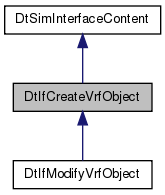
class DtIfCreateVrfObject:
Instances of DtIfCreateVrfObject are the message content for create vrf object messages sent from one VR-Forces process to another. The purpose of the message is to request that a particular VR-Forces process instantiate and become responsible for locally simulating a new vrf object.
Content-Type: DtCreateVrfObjectMessageType
Parameters: vrf process address - A DtSimulationAddress identifying the particular VR-Forces back-end to create the object.
object name - A DtString used to uniquely identify the object. This string must be unique for all objects in the exercise.
object type - The DtObjectType of the new entity. DtObjectType is an extension of the DIS/RPR enumerated DtEntityType (from objTypeEnums.h).
force type - The DtForceType value for the new entity (from disE- nums.h).
object label - A DtString associated with the new object. This string provides an additional means to identify an object without the strict uniqueness requirement of object name.
extended labels - A key/value pair that will assign a label to a label index. Index 0 is reserved, so, that will be ignored if used
position - A DtVector that is the starting location of the object in geocentric coordinates. Set the position for those objects that have a single vertex (e.g. waypoints, entities).
heading - A DtReal value that is the initial heading of the object in radians. A value of 0.0 is north and positive values are clockwise.
vertices - A DtList of the DtVectors that make up the object's geom- etry (i.e. the vertices that make up the points along a route). Note that position is just an alias for the first vertex. Do not call setPosi- tion() if you have an object with multiple vertices (call addVertex() to set up the object's geometry instead). Vertices must be specified in geocentric coordinates.
projection - A bool flag indicating whether or not the Z elements in the object's vertex list have meaning. For example, phase lines do not have meaningful Z elements.
closed figure - A bool flag indicating whether the object's vertices make up a closed figure (i.e. does the last vertex connect with the first?). A control area is an example of an object that is a closed figure.
appearance - A DtAppearance indicating the initial appearance of the object (e.g. damage state, frozen status, concealed).
create subobjects - A bool flag indicating whether or not you wish to have sub-object created. The parameter file may contain a list of subobjects. When building from the bottom up (for example, using AggregateAs or explicitly calling addSubordinate) then the subobjects in the parameter list should be ignored.