Public Member Functions |
| | DtIntersector (DtDe &de) |
| | CTOR.
|
| virtual | ~DtIntersector () |
| | DTOR.
|
| virtual void | setDynamicOceanProperties (DynamicOceanProperties properties) |
| | If an ocean layer exists, determine if it should be ignored, use mean sea level, or wave height.
|
| DynamicOceanProperties | dynamicOceanProperties () const |
| | Return the current dynamic ocean properties.
|
| virtual bool | findNearestIntersectionToPoint (double x, double y, double z, double vx, double vy, double vz, DtIntersectorResult &intersection, IntersectProperties properties=AllNodes, std::vector< DtElementID > *ignoreList=0, bool returnTriangle=false, double maxIsectorLength=-1., bool useHighLod=false)=0 |
| | Find the nearest scene intersection from a point (x,y,z) along a vector(vx,vy,vz) The useHighLod argument tells the intersector that if the terrain is an osgEarth terrain, don't settle for whatever is paged in; get the highest LOD from the map server for this location and use that Note that if maxIsectorLength is not set, the default is the diameter of the database, which for large (and especially geocentric) databases and world databases, may be too large to get adequate precision when trying to interect small (high resolution) triangles.
|
| virtual bool | findAllIntersectionsThroughPoint (double x, double y, double z, double vx, double vy, double vz, DtIntersections &intersections, IntersectProperties properties=AllNodes, std::vector< DtElementID > *ignoreList=0, bool sort=true, bool useHighLod=false)=0 |
| | Return a list of all intersections along the line passing through <x,y,z> and directed by <vx, vy, vz> The useHighLod argument tells the intersector that if the terrain is an osgEarth terrain, don't settle for whatever is paged in; get the highest LOD from the map server for this location and use that.
|
| virtual bool | findFirstIntersectWithLineSegment (double x, double y, double z, double end_x, double end_y, double end_z, DtIntersectorResult &intersection, IntersectProperties properties=AllNodes, std::vector< DtElementID > *ignoreList=0, bool useHighLod=false)=0 |
| | find first intersection along segment x,y,z to end_x, end_y, end_z.
|
| virtual bool | findAllIntersectWithLineSegment (double x, double y, double z, double end_x, double end_y, double end_z, DtIntersections &intersections, IntersectProperties properties=AllNodes, std::vector< DtElementID > *ignoreList=0, bool sort=true, bool useHighLod=false)=0 |
| | find all intersections along segment x,y,z to end_x, end_y, end_z.
|
| virtual bool | pick (DtChannel &channel, double mx, double my, DtIntersectorResult &intersection, IntersectProperties properties=AllNodes, std::vector< DtElementID > *ignoreList=0)=0 |
| | Find the object (if any) under the mouse mx, my are in window coordinates; cx, cy, cz are returned in database coordinates.
|
| virtual bool | pickAll (DtChannel *channel, double mx, double my, DtIntersections &intersections, IntersectProperties properties=AllNodes, std::vector< DtElementID > *ignoreList=0)=0 |
| | Find all the objects (if any) under the mouse mx, my are in window coordinates.
|
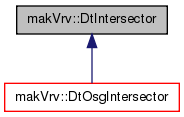
DtIntersector is an abstract class that provides the interface for requesting intersections with the scene graph.
| virtual bool makVrv::DtIntersector::findNearestIntersectionToPoint |
( |
double |
x, |
|
|
double |
y, |
|
|
double |
z, |
|
|
double |
vx, |
|
|
double |
vy, |
|
|
double |
vz, |
|
|
DtIntersectorResult & |
intersection, |
|
|
IntersectProperties |
properties = AllNodes, |
|
|
std::vector< DtElementID > * |
ignoreList = 0, |
|
|
bool |
returnTriangle = false, |
|
|
double |
maxIsectorLength = -1., |
|
|
bool |
useHighLod = false |
|
) |
| |
|
pure virtual |
Find the nearest scene intersection from a point (x,y,z) along a vector(vx,vy,vz) The useHighLod argument tells the intersector that if the terrain is an osgEarth terrain, don't settle for whatever is paged in; get the highest LOD from the map server for this location and use that Note that if maxIsectorLength is not set, the default is the diameter of the database, which for large (and especially geocentric) databases and world databases, may be too large to get adequate precision when trying to interect small (high resolution) triangles.
It is recommended that you set the isector length to something more specific if possible, like the altitude of the observer + a constant, for example; or, for osgEarth databases, useHighLod=true, which will also eliminate the problem.
- Return values
-
| false | if no intersection was found (and the isect record is NOT set). |
Implemented in makVrv::DtOsgIntersector.
| virtual bool makVrv::DtIntersector::findAllIntersectWithLineSegment |
( |
double |
x, |
|
|
double |
y, |
|
|
double |
z, |
|
|
double |
end_x, |
|
|
double |
end_y, |
|
|
double |
end_z, |
|
|
DtIntersections & |
intersections, |
|
|
IntersectProperties |
properties = AllNodes, |
|
|
std::vector< DtElementID > * |
ignoreList = 0, |
|
|
bool |
sort = true, |
|
|
bool |
useHighLod = false |
|
) |
| |
|
pure virtual |
find all intersections along segment x,y,z to end_x, end_y, end_z.
The useHighLod argument tells the intersector that if the terrain is an osgEarth terrain, don't settle for whatever is paged in; get the highest LOD from the map server for this location and use that
- Return values
-
| false | if no intersection was found (and the isect record list has size 0). |
Implemented in makVrv::DtOsgIntersector.