 |
VR-Forces Development_Version Class Documentation
|


All Classes Namespaces Files Functions Variables Typedefs Enumerations Enumerator Friends Macros Groups Pages
|
VR-Forces Development_Version Class Documentation
|
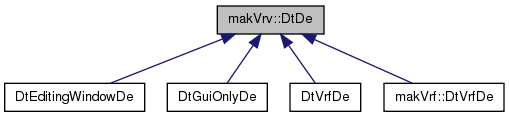
The DtDe is the core component of any VR-Vantage application. More...
Public Types | |
| enum | InitializationResult { Initialized = 1, UnableToInitialize = 0, UnableToInitializeDueToLicense = -1 } |
| Result codes for the initialize() function. More... | |
| typedef std::vector< std::pair < DtDeError, bool > > | DeErrors |
| Typedef of a vector of error/critical. | |
Public Member Functions | |
| DtDe () | |
| CTOR. | |
| virtual | ~DtDe () |
| DTOR occur after the subclass of DtDe has been called. | |
| bool | destructing () |
| Get if the Display Engine is in the process of destructing (typically steps like disconnecting signals is unnecessary). | |
| virtual void | setDeInitializer (const DtDeInitializer &initializer) |
| Set the Display Engine initializer used to initialize the Display Engine. | |
| virtual void | setPathConfiguration (const DtDePathConfiguration &pathConfig) |
| Set the path configuration for an uninitialized Display Engine. | |
| virtual InitializationResult | initialize (bool abortOnLicenseFailure=true, bool useLicenseErrorDialog=true) |
| Initialize the application prior to running it. | |
| bool | initialized () const |
| Get whether the application is initialized. | |
| DtThreadId | threadId () |
| Get the thread id that the Display Engine was initialized in and must rung in. | |
| virtual void | setDeConfiguration (const DtDeConfiguration &deConfig) |
| Set the de configuration. | |
| virtual void | tick (double simTime) |
| A very important function which provides a since tick of execution which is required for the app to run for one 'logical' frame. | |
| void | retick () |
| Retick is a helper function for simply ticking using the current Simulation time. | |
| virtual bool | timeToStop () const |
| Method for checking to see if the app should stop ticking. | |
| virtual void | setTimeToStop (bool flag=true) |
| Set whether it is time to stop ticking. | |
| virtual void | quit () |
| Call this method to quit and exit the application. | |
| virtual void | reset () |
| Resets DtIG to a pre-configured state. | |
| void | updateScene () |
| Update the scene if it needs to be updated. | |
| void | registerInitFunction (void *address) |
| Register address of init function so DtDe instance knows that module was already instanced. | |
| bool | isInitFunctionRegistered (void *address) |
| Returns true if init function has already been registered. | |
| bool | shouldSendMesssage () |
| Helper function used to check if a message needs to be created and sent. | |
| void | setPagedLodMagnificationScaleFactor (float factor) |
| float | pagedLodMagnificationScaleFactor () const |
Accessors | |
| virtual const DtDeConfiguration & | deConfiguration () const |
| DtDeConfiguration accessor. | |
| virtual DtDeCommunicator & | igCommunicator () |
| DtDeCommunicator accessor. | |
| DtMainEventQueue & | mainEventQueue () |
| DtMainEventQueue. | |
| virtual DtDisplay * | display () |
| DtDisplay accessor. | |
| virtual DtScene & | scene () |
| The DtScene accessor. | |
| virtual DtDataBank & | dataBank () |
| The DtDataBank accessor. | |
| virtual DtDriverManager & | driverManager () |
| The DtMasterScene accessor. | |
| bool | driverManagerCreated () const |
| You can call this method to see if the DtDriverManager exists. | |
| virtual DtMessageDispatcher & | dispatcher () |
| DtMessageDispatcher accessor. | |
| DtDebugLog & | log () |
| Inline access for the debug log object. | |
| DtAgentManager & | agentManager () |
| Get the scene manager. | |
| virtual double | simulationTime () const |
| Get the simulation time. | |
| virtual double | syncedTime () const |
| Get the simulation time or the synced NTP time (if the –hasNTPSync / -O flag has been set) Currently this method is used to synchronize triton ocean and speedtree. | |
| virtual DtSynchronizedTimeManager * | findSynchronizedTimeManager () |
| The DtSynchronizedTimeManager manages synchronized time when used. | |
| virtual int | displayCount () const |
| Get the display count. | |
| virtual const DtDeInitializer & | deInitializer () const |
| Return the DtDeInitializer. | |
| virtual const DtDePathConfiguration & | dePathConfiguration () const |
| Return the DtDePathConfiguration. | |
| virtual bool | isInMasterMode () const |
| Returns true if the DtDe is in master mode. | |
| virtual bool | isInSlaveMode () const |
| Returns true if the DtDe is in slave mode. | |
| virtual DtDeSharedState & | sharedState () |
| Returns the DtDeSharedState object. | |
| virtual const DtSchemaManager & | schemaManager () const |
| DtSchemaManager accessor. | |
| virtual DtSchemaManager & | schemaManager () |
| DtDeConfiguration accessor. | |
| virtual DtFileCache * | fileCache () |
| Returns DtFileCache. | |
| virtual const DeErrors & | deErrors () const |
| Returns myIgErrors. | |
| virtual void | clearDeErrors () |
| Clears myIgErrors. | |
| virtual DtRenderer & | renderer () const |
| Get the renderer. | |
| bool | renderFrameThisTick () const |
| Gets if we will render this frame. | |
| virtual bool | licenseAvailable () const |
| Gets if a license can be found to run with the features specified in the DtDeInitializer. | |
Distributed Functions | |
| virtual bool | addDisplayConfiguration (const DtDisplayConfiguration &) |
| Add a new display, if the display engine matches the local name then the de display engine is realized. | |
| virtual void | realizeDisplayConfiguration (const std::string &clientName, const std::string &displayName) |
| Make a client realize a display configuration. | |
| virtual void | destroyDisplay (DtDisplayProxySP display) |
| Remove a display. | |
| virtual void | destroyDisplay (const std::string &displayName) |
| Remove a display. | |
| virtual void | destroyAllDisplays () |
| Removes all display. | |
| virtual bool | modifyDisplay (const std::string &displayName, const DtDisplayConfiguration &config) |
| Modify a display. | |
Slots | |
| virtual void | onSlaveConnected (const std::string &igName) |
| Called when a client is added. | |
| virtual void | emitDeError (const DtDeError &error, bool criticalError) |
| Called when an error is emitted. | |
Static Public Member Functions | |
| static const char * | className () |
| Returns the name of this class. | |
Public Attributes | |
Signals | |
| boost::signal< void()> | signal_initializeDefaultState |
| Signal emitted during initialization at at time when it is possible to initialize default state. | |
| boost::signal< void()> | signal_postInitialize |
| Signal emitted at the end of the initialization function. | |
| boost::signal< void(DtDe &)> | signal_preTick |
| Signal emitted at the beginning of the tick function. | |
| boost::signal< void()> | signal_postTick |
| Signal emitted at the end of the tick function. | |
| boost::signal< void(const std::string &, const std::string &)> | signal_displayConfigurationRealized |
| Emitted when a Display Engine is told to realize a display configuration. | |
| boost::signal< void(const DtDisplayConfiguration &)> | signal_displayConfigurationAdded |
| Emitted when a display is added. | |
| boost::signal< void(const std::string &)> | signal_displayToBeDestroyed |
| Emitted when a display is removed. | |
| boost::signal< void(const std::string &, const DtDisplayConfiguration &)> | signal_displayModified |
| Emitted when a display is modified. | |
| boost::signal< void(const std::string &, const DtWindowConfiguration &)> | signal_windowConfigurationAdded |
| Emitted when a window is added. | |
| boost::signal< void(const std::string &, const std::string &)> | signal_windowConfigurationToBeDestroyed |
| Emitted when a window is destroyed. | |
| boost::signal< void(const std::string &, const std::string &, const DtWindowConfiguration &)> | signal_windowConfigurationModified |
| Emitted when an realized window is modified. | |
| boost::signal< void(const std::string &, const std::string &, const DtChannelConfiguration &)> | signal_channelConfigurationAdded |
| Emitted when a channel is added. | |
| boost::signal< void(const std::string &, const std::string &, const std::string &)> | signal_channelToBeDestroyed |
| Signal is emitted, then the channel is destroyed. | |
| boost::signal< void(const std::string &, const std::string &, const std::string &, const DtChannelConfiguration &)> | signal_channelConfigurationModified |
| Emitted when a channel is modified. | |
| boost::signal< void(const DtDeError &error, bool critical)> | signal_deError |
| Listen to this signal for Display Engine errors. | |
| boost::signal< void()> | signal_quit |
| Signal emitted by the quit method. | |
Protected Types | |
| enum | LicenseTypes { NoLicense = -1, Master3D_License = 0, XR_License = 1, PVD_License = 2 } |
| typedef std::vector< void * > | InitFunctionVector |
| This vector stores the address of registered init functions. | |
| typedef std::map< std::string, DtVirtualBaseClass * > | RootedSingletonMap |
| typedef std::map < StaticInstanceFunction, DtVirtualBaseClass * > | FastRootedSingletonMap |
| typedef std::map< std::string, DtDisplayProxyWP > | DisplayEngineProxyMap |
Protected Member Functions | |
| void | slaveTick () |
| void | masterTick (double simulationTime) |
| void | renderTick () |
| Update the scene and render. | |
| DtDeProctor * | proctor () |
| Get the proctor. | |
| virtual bool | local_realizeDisplayConfiguration (const std::string &clientName, const std::string &displayName) |
| Attempt to realize a display configuration. | |
| virtual void | local_destroyDisplay (const std::string &displayName) |
| Remove a display. | |
| virtual bool | local_modifyDisplay (const std::string &displayName, const DtDisplayConfiguration &config) |
| Modify a display. | |
| void | createDisplay (DtDisplayConfiguration &) |
| create the display engine. | |
| void | createIgCommunicator (DtDriverConfiguration &config) |
| Create the Display Engine Driver. | |
| void | destroyDisplay () |
| Destroy the display. | |
| bool | local_addDisplayConfiguration (const DtDisplayConfiguration &dec) |
| Internal implementation of adding a display. | |
Protected methods | |
| virtual unsigned int | countEmbeddedWindows (const DtDisplayConfiguration &dec) |
| Count the number of embedded windows in the display configuration. | |
Initialization helper functions | |
| virtual void | initializeSchemaManager () |
| Check whether the DtDe should skip this tick to maintain a fixed frame rate. | |
| virtual void | initializeLibXmlIfNecessary () |
| Check whether the DtDe should skip this tick to maintain a fixed frame rate. | |
| virtual bool | shouldSkipThisTick (double simulationTime) |
| Check whether the DtDe should skip this tick to maintain a fixed frame rate. | |
| virtual void | postInitialize () |
| Connect initialized components and call postInit signal. | |
| virtual void | postInitializeMaster () |
| Master-only post initialize code. | |
| virtual void | checkForData () |
| Check that the data package is installed, and emit an error if not. | |
Static Protected Attributes | |
| static const char * | myClassName |
Friends | |
| class | DtDeProctor |
Local Functions | |
| typedef DtVirtualBaseClass &(* | StaticInstanceFunction )(DtDe &) |
| Define the static instance function type for fast instance lookup. | |
| virtual void | setSimulationTime (double time) |
| Set the simulation time. | |
| virtual double | systemTime () const |
| Used in special cases of absolute time stamping, this will return absolute wall clock time from the DtClock. | |
| virtual DtVirtualBaseClass * | findFastInstance (StaticInstanceFunction classInstanceFunction) const |
| Find an instance with the given name. | |
| template<typename Class > | |
| DtVirtualBaseClass * | findFastInstance (Class &(*staticInstFunc)(DtDe &)) const |
| The instance key is always return the subclass of the virtual base class, since it returns a reference (aka a pointer) it is safe to cast the function pointer. | |
| virtual void | registerFastInstance (StaticInstanceFunction classInstanceFunction, DtVirtualBaseClass *inst) |
| Register a fast instance, if the inst is a null pointer the instance key is removed. | |
| template<typename Class > | |
| void | registerFastInstance (Class &(*staticInstFunc)(DtDe &), DtVirtualBaseClass *inst) |
| The instance key is always return the subclass of the virtual base class, since it returns a reference (aka a pointer) it is safe to cast the function pointer. | |
| virtual DtVirtualBaseClass * | findInstance (const std::string &instanceName) const |
| Find an instance with the given name. | |
| virtual void | registerInstance (const std::string &instanceName, DtVirtualBaseClass *instance) |
| Register an instance with a given name for later retrieval. | |
| virtual void | registerProctor (unsigned short handlerId, DtProctor *) |
| Register an proctor object. | |
| virtual void | unregisterProctor (unsigned short handlerId) |
| Unregister a handler This should be called before the handler is deallocated. | |
| DtProctor * | findProctor (unsigned short handlerId) const |
| Find a handler. | |
| DtDisplayProxySP | findDisplay (const std::string &displayName) |
| Find a Display by name. | |
| virtual DtDisplayProxySP | findDisplayByIndex (int index) |
| Get the display by index. | |
| void | setRenderFrameThisTick (bool update) |
| Sets that the frame will be rendered this tick. | |
| virtual bool | isValidDisplayConfiguration (const DtDisplayConfiguration &dec) |
| Returns true if the display configuration is valid and can be realized. | |
The DtDe is the core component of any VR-Vantage application.
It owns a DtRenderer, DtDeCommunicator, as well as a DtDisplay and other things.
| typedef std::vector<std::pair<DtDeError,bool> > makVrv::DtDe::DeErrors |
Typedef of a vector of error/critical.
| typedef DtVirtualBaseClass&(* makVrv::DtDe::StaticInstanceFunction)(DtDe &) |
Define the static instance function type for fast instance lookup.
|
protected |
This vector stores the address of registered init functions.
|
protected |
|
protected |
|
protected |
Result codes for the initialize() function.
|
protected |
| makVrv::DtDe::DtDe | ( | ) |
CTOR.
|
virtual |
DTOR occur after the subclass of DtDe has been called.
| bool makVrv::DtDe::destructing | ( | ) |
Get if the Display Engine is in the process of destructing (typically steps like disconnecting signals is unnecessary).
During destruction members will become invalid.
|
virtual |
Set the Display Engine initializer used to initialize the Display Engine.
This call will do nothing if the Display Engine is already initialized. Also sets the DtDePathConfiguration and DtDeConfiguration from the initializer
|
virtual |
Set the path configuration for an uninitialized Display Engine.
This call will do nothing if the Display Engine is already initialized. Note: setDeInitializer will override the path configuration with the initializer's path configuration
|
virtual |
Initialize the application prior to running it.
It is required that this function be called prior to a call to run. If the default DtDe::run is not used, and rather tick is called repeatedly, it is still required that this function get called. Note that the Display Engine must run in the thread that calls initialize. If useLicenseErrorDialog is true and the appropriate DLLs have been included, failure to check out a VR-Vantage license will cause a dialog to be raised requesting licensing information. (this may still ultimately result in not finding a license). If abortOnLicenseFailure is true, the application will exit on license failure. Set this to false to utilize the InitializationResult return value.
Reimplemented in DtGuiOnlyDe.
| bool makVrv::DtDe::initialized | ( | ) | const |
Get whether the application is initialized.
Referenced by makVrv::defaultManagerInstanceFunction().
| DtThreadId makVrv::DtDe::threadId | ( | ) |
Get the thread id that the Display Engine was initialized in and must rung in.
| DtCorruptedState | if called before initialized. |
|
virtual |
Set the de configuration.
This call is only valid BEFORE calls to initialize. Note: setDeInitializer will override the de configuration with the initializer's de configuration Throws DtCorruptsState if the Display Engine has already been initialized.
|
virtual |
A very important function which provides a since tick of execution which is required for the app to run for one 'logical' frame.
This function must be called repeatedly typically as often as possible.
| DtCorruptedState | if called before the Display Engine is initialized. |
| Input | |
| simTime | is the simulation time of the 'update cycle'. Typically this is the amount of time in seconds since the DtDe was started (to get real time behavior). |
Reimplemented in DtGuiOnlyDe, and makVrf::DtVrfDe.
|
inline |
Retick is a helper function for simply ticking using the current Simulation time.
This may be necessary if performing multiple 'passes' over the same time.
|
virtual |
Method for checking to see if the app should stop ticking.
This works only with the defaultRun function, unless explicitly used in the alternate run function's implementation.
|
virtual |
Set whether it is time to stop ticking.
|
virtual |
Call this method to quit and exit the application.
Reimplemented in makVrf::DtVrfDe.
|
virtual |
Resets DtIG to a pre-configured state.
| void makVrv::DtDe::updateScene | ( | ) |
Update the scene if it needs to be updated.
|
virtual |
DtDeConfiguration accessor.
|
virtual |
DtDeCommunicator accessor.
| DtCorruptedState | if called before the Display Engine is initialized. |
| DtMainEventQueue& makVrv::DtDe::mainEventQueue | ( | ) |
|
virtual |
DtDisplay accessor.
The returned pointer will be NULL before initialize is called, and may be null after.
|
virtual |
The DtScene accessor.
| DtCorruptedState | if called before the Display Engine is initialized. |
| DtCorruptedState | if the Display Engine is configured to be a slave. |
Referenced by makVrf::DtDisabledEnvironment::getEnvironmentNames().
|
virtual |
The DtDataBank accessor.
| DtCorruptedState | if the Display Engine is configured to be a slave. |
Referenced by makVrv::DtSimObjectEntryCollection< T >::DtSimObjectEntryCollection(), and makVrv::DtStateViewCollection< T >::DtStateViewCollection().
|
virtual |
The DtMasterScene accessor.
The function will throw before the initialize function is called.
| DtCorruptedState | if called before the Display Engine is initialized. |
| bool makVrv::DtDe::driverManagerCreated | ( | ) | const |
You can call this method to see if the DtDriverManager exists.
|
virtual |
DtMessageDispatcher accessor.
|
inline |
Inline access for the debug log object.
| DtAgentManager& makVrv::DtDe::agentManager | ( | ) |
Get the scene manager.
| DtCorruptedState | if called before the Display Engine is initialized. |
Referenced by makVrv::Cast< DesiredType >::toFunctionType().
|
virtual |
Get the simulation time.
|
virtual |
Get the simulation time or the synced NTP time (if the –hasNTPSync / -O flag has been set) Currently this method is used to synchronize triton ocean and speedtree.
|
virtual |
The DtSynchronizedTimeManager manages synchronized time when used.
The accessor to it makes it possible to use the sync time manager's API, which allows for time scaling and a time offset. These are not used in VR-Vantage
|
virtual |
Get the display count.
|
virtual |
Return the DtDeInitializer.
Referenced by makVrv::DtCommonBaseSettingsManager< makArchives::DtEntitySettingsRecord >::loadDefaults().
|
virtual |
Return the DtDePathConfiguration.
|
virtual |
Returns true if the DtDe is in master mode.
|
virtual |
Returns true if the DtDe is in slave mode.
Referenced by makVrv::defaultManagerInstanceFunction().
|
virtual |
Returns the DtDeSharedState object.
|
virtual |
DtSchemaManager accessor.
| DtCorruptedState | if called before the DtDe is initialized. |
|
virtual |
DtDeConfiguration accessor.
|
virtual |
Returns DtFileCache.
|
virtual |
Returns myIgErrors.
|
virtual |
Clears myIgErrors.
|
virtual |
Get the renderer.
| bool makVrv::DtDe::renderFrameThisTick | ( | ) | const |
Gets if we will render this frame.
|
virtual |
Gets if a license can be found to run with the features specified in the DtDeInitializer.
Therefore this must be called AFTER SetDeInitializer to get the correct result
|
virtual |
Add a new display, if the display engine matches the local name then the de display engine is realized.
This function should not be called before the display engine is initialized
|
virtual |
Make a client realize a display configuration.
| Input | |
| clientName | is the name of the client, this is queriable from the master DtDe's client list. |
| displayName | is the name of the display configuration to realize. |
| DtInvalidInput | if no client has the clientName or if no configuration has the displayName. |
|
virtual |
Remove a display.
The proxy will be invalid after this call, and can not be used.
|
virtual |
Remove a display.
If the display matches the local name then the de display is destroyed.
|
virtual |
Removes all display.
|
virtual |
Modify a display.
|
virtual |
Set the simulation time.
Reimplemented in makVrf::DtVrfDe.
|
virtual |
Used in special cases of absolute time stamping, this will return absolute wall clock time from the DtClock.
This might or might not be the same time as the simulationTime
|
virtual |
Find an instance with the given name.
If no instance is found than a null pointer is returned.
Referenced by makVrv::defaultManagerInstanceFunction().
|
inline |
The instance key is always return the subclass of the virtual base class, since it returns a reference (aka a pointer) it is safe to cast the function pointer.
|
virtual |
Register a fast instance, if the inst is a null pointer the instance key is removed.
|
inline |
The instance key is always return the subclass of the virtual base class, since it returns a reference (aka a pointer) it is safe to cast the function pointer.
|
virtual |
Find an instance with the given name.
If no instance is found than a null pointer is returned.
Referenced by makVrv::DtSubjectAnnouncer< T >::findInstance().
|
virtual |
Register an instance with a given name for later retrieval.
Once registered, the DtDe takes ownership and manages the lifetime of the instance. Ownership cannot be transfered back from the DtDe. Registering a new instance under an existing name will cause the existing instance to be destroyed. Registering a NULL instance under an existing name will cause the existing instance to be destroyed. Because the DtDe manages the lifetime of the registered instances, do not save handles to any instance as they can be destroyed without notice.
Referenced by makVrv::DtSubjectAnnouncer< T >::findInstance().
|
virtual |
Register an proctor object.
|
virtual |
Unregister a handler This should be called before the handler is deallocated.
| DtProctor* makVrv::DtDe::findProctor | ( | unsigned short | handlerId | ) | const |
Find a handler.
| DtDisplayProxySP makVrv::DtDe::findDisplay | ( | const std::string & | displayName | ) |
Find a Display by name.
| DtCorruptedState | if proxy is invalid. |
|
virtual |
Get the display by index.
| void makVrv::DtDe::setRenderFrameThisTick | ( | bool | update | ) |
Sets that the frame will be rendered this tick.
|
virtual |
Returns true if the display configuration is valid and can be realized.
|
virtual |
Called when a client is added.
Called when an error is emitted.
|
static |
Returns the name of this class.
Required for DtSubjectAnnouncer::findInstance().
| void makVrv::DtDe::registerInitFunction | ( | void * | address | ) |
Register address of init function so DtDe instance knows that module was already instanced.
| bool makVrv::DtDe::isInitFunctionRegistered | ( | void * | address | ) |
Returns true if init function has already been registered.
|
inline |
Helper function used to check if a message needs to be created and sent.
|
inline |
|
inline |
|
protectedvirtual |
Count the number of embedded windows in the display configuration.
|
protectedvirtual |
Check whether the DtDe should skip this tick to maintain a fixed frame rate.
Reimplemented in makVrf::DtVrfDe.
|
protectedvirtual |
Check whether the DtDe should skip this tick to maintain a fixed frame rate.
|
protectedvirtual |
Check whether the DtDe should skip this tick to maintain a fixed frame rate.
|
protectedvirtual |
Connect initialized components and call postInit signal.
Reimplemented in DtGuiOnlyDe, DtEditingWindowDe, and DtVrfDe.
|
protectedvirtual |
Master-only post initialize code.
|
protectedvirtual |
Check that the data package is installed, and emit an error if not.
|
protected |
|
protected |
|
protected |
Update the scene and render.
|
protected |
Get the proctor.
|
protectedvirtual |
Attempt to realize a display configuration.
|
protectedvirtual |
Remove a display.
If the display matches the local name then the de display is destroyed.
|
protectedvirtual |
Modify a display.
|
protected |
create the display engine.
|
protected |
Create the Display Engine Driver.
|
protected |
Destroy the display.
|
protected |
Internal implementation of adding a display.
|
friend |
| boost::signal<void ()> makVrv::DtDe::signal_initializeDefaultState |
Signal emitted during initialization at at time when it is possible to initialize default state.
The De will not be initialized, also other objects may not exist. Typically it is only safe for an object to connect to this signal to initialize itself often from a file on disk.
| boost::signal<void ()> makVrv::DtDe::signal_postInitialize |
Signal emitted at the end of the initialization function.
This is useful for executing code after the Display Engine is initialized, but before it starts running. Such as updating values from settings objects since they cannot be accessed during initialization.
| boost::signal<void (DtDe&)> makVrv::DtDe::signal_preTick |
Signal emitted at the beginning of the tick function.
This is useful for executing code before the Display Engine does anything during its tick. Sometimes there is code which is necessary for multiplexing the Display Engine aka setting the Display Engine by a temporal pattern since multiple IGs may not tick at the same time.
| boost::signal<void ()> makVrv::DtDe::signal_postTick |
Signal emitted at the end of the tick function.
This is useful for executing code after the Display Engine does everything during its tick. Sometimes there is code which is necessary for multiplexing the Display Engine aka setting the Display Engine by a temporal pattern since multiple IGs may not tick at the same time.
| boost::signal<void (const std::string&, const std::string&)> makVrv::DtDe::signal_displayConfigurationRealized |
Emitted when a Display Engine is told to realize a display configuration.
Signal with the name of the Display Engine, and the name of the Display realized.
| boost::signal<void (const DtDisplayConfiguration&)> makVrv::DtDe::signal_displayConfigurationAdded |
Emitted when a display is added.
Signal with a const DtDisplayConfiguration& argument and a void return value.
| boost::signal<void (const std::string&)> makVrv::DtDe::signal_displayToBeDestroyed |
Emitted when a display is removed.
The signal is emitted then the configuration is destroyed. Signal with a const std::string& argument and a void return value.
| boost::signal<void (const std::string&, const DtDisplayConfiguration&)> makVrv::DtDe::signal_displayModified |
Emitted when a display is modified.
Signal with display engine name and display configuration argument and a void return value.
| boost::signal<void (const std::string&, const DtWindowConfiguration&)> makVrv::DtDe::signal_windowConfigurationAdded |
Emitted when a window is added.
Signal with a display engine name and DtViewConfiguration argument and a void return value.
| boost::signal<void (const std::string&, const std::string&)> makVrv::DtDe::signal_windowConfigurationToBeDestroyed |
Emitted when a window is destroyed.
The signal is emitted then the configuration is destroyed. Signal with a display engine name and a window name argument and a void return value.
| boost::signal<void (const std::string&, const std::string&, const DtWindowConfiguration&)> makVrv::DtDe::signal_windowConfigurationModified |
Emitted when an realized window is modified.
Signal with a display engine name and a window name and window config argument and a void return value.
| boost::signal<void (const std::string&, const std::string&, const DtChannelConfiguration&)> makVrv::DtDe::signal_channelConfigurationAdded |
Emitted when a channel is added.
Signal with a display engine name, window name and DtChannelConfiguration argument and a void return value.
| boost::signal<void (const std::string&, const std::string&, const std::string&)> makVrv::DtDe::signal_channelToBeDestroyed |
Signal is emitted, then the channel is destroyed.
Signal with a display engine name,window name and channel name arguments and a void return value.
| boost::signal<void (const std::string&, const std::string&, const std::string&, const DtChannelConfiguration&)> makVrv::DtDe::signal_channelConfigurationModified |
Emitted when a channel is modified.
Signal with a display engine name, window name , old channel name and DtChannelConfiguration argument and a void return value.
Listen to this signal for Display Engine errors.
DO NOT EMIT using this signal. Emit using the emit function below.
| boost::signal<void ()> makVrv::DtDe::signal_quit |
Signal emitted by the quit method.
Applications should listen for this signal and respond appropriately.
|
staticprotected |
|
protected |
|
protected |
|
protected |
|
protected |
|
protected |
|
protected |
|
protected |
|
protected |
|
protected |
|
protected |
|
protected |
|
protected |
|
protected |
|
protected |
|
protected |
|
protected |
|
protected |
|
protected |
|
protected |
|
protected |
|
protected |
|
protected |
|
protected |
|
protected |
|
protected |
|
protected |
|
protected |
|
protected |
|
protected |
|
mutableprotected |
|
mutableprotected |
|
protected |
|
protected |
|
protected |
|
protected |
|
protected |
|
protected |