 |
VR-Forces 4.6.1 Class Documentation
|


All Classes Namespaces Files Functions Variables Typedefs Enumerations Enumerator Properties Friends Macros Groups Pages
|
VR-Forces 4.6.1 Class Documentation
|
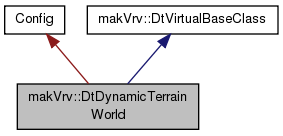
Container for dynamic terrain features, change requests, and queries. More...
Classes | |
| class | FeatureHandle |
| Feature Insertion/Removal/Paging Features represent parts of the terrain which are individually identifiable to the terrain system. More... | |
| class | QueryEndException |
| Can be thrown from query callback to remove query. More... | |
| class | QueryHandle |
| Queries. More... | |
Public Member Functions | |
| DtDynamicTerrainWorld (Config *config=0) | |
| Default constructor. | |
| virtual | ~DtDynamicTerrainWorld () |
| Virtual destructor. | |
| void | setDisabled () |
| Disable the dynamic terrain world. | |
| bool | isDisabled () const |
| virtual | ~Config () |
| virtual double | minTileArea () const =0 |
| virtual double | maxTileArea () const =0 |
| virtual FeatureHandle | pageInFeature (const boost::shared_ptr< DtDynamicTerrainFeature > &feature) |
| Add a feature to the system. | |
| virtual QueryHandle | queryFeatures (const boost::function< void(const DtDynamicTerrainFeature &)> &callback, DtDynamicTerrainChange *command=0, bool useOriginalGeometry=false) |
| Install a query which will call the supplied callback on matching features as they are paged in. | |
| virtual QueryHandle | queryFeatures (const boost::function< void(const DtDynamicTerrainFeature &)> &callback, DtDynamicTerrainGeometry *geometry, bool useOriginalGeometry=false) |
| virtual void | queryCurrentFeatures (const boost::function< void(const DtDynamicTerrainFeature &)> &, DtDynamicTerrainChange *command=0, bool useOriginalGeometry=false) |
| virtual void | queryCurrentFeatures (const boost::function< void(const DtDynamicTerrainFeature &)> &, DtDynamicTerrainGeometry *geometry, bool useOriginalGeometry=false) |
 Public Member Functions inherited from makVrv::DtVirtualBaseClass Public Member Functions inherited from makVrv::DtVirtualBaseClass | |
| DtVirtualBaseClass () | |
| Do nothing constructor. | |
| virtual | ~DtVirtualBaseClass () |
| Virtual do nothing destructor. | |
Static Public Member Functions | |
| static DtDynamicTerrainWorld & | instance (DtDe &) |
| Get rooted singleton from DE. | |
| static void | setInstance (DtDe &de, DtDynamicTerrainWorld *world) |
| Set the rooted singleton to a specific object. | |
| static unsigned long long | GetQueryCount () |
Protected Member Functions | |
| virtual QueryHandle | queryFeatures (QueryInfo *query) |
Protected Attributes | |
| Impl * | myImpl |
Private Member Functions | |
| DtDynamicTerrainWorld (const DtDynamicTerrainWorld &) | |
| Non-copyable. | |
| DtDynamicTerrainWorld & | operator= (const DtDynamicTerrainWorld &) |
| typedef DtDynamicTerrainFeature::RequestHandle | RequestHandle |
| Change Requests. | |
| virtual RequestHandle | addChangeRequest (DtDynamicTerrainChange *command) |
| Add a change request to the system. | |
| virtual RequestHandle | addChangeRequest (DtDynamicTerrainTimeType time, DtDynamicTerrainChange *command) |
| Convenience wrapper around the main addChangeRequest function which adds a time parameter. | |
Container for dynamic terrain features, change requests, and queries.
Dynamic terrain features are objects which implement some kind of change that can be made in the terrain. Change requests consist of data (sets of key/value pairs) and geometry and represent some kind of change to the terrain.
When features and change requests are added, the system determines if the change request applies to the features. This is done so that regardless of what order the features and change requests are added in, they will still all be checked against each other. Whether a change request "applies" to a feature is completely up to the implementation of the feature. Features have geometry which must intersect the change request geometry, and then each feature gets a chance to view the request data and decide if it knows how to handle it. If a change request doesn't apply to a feature then they don't interact at all.
All of the change requests that apply to a given feature are collected into an interface and exposed to the feature in DtDynamicTerrainFeature::changeState(). The feature can all of the changes that could possibly have an effect on the feature state and decide what to do given all of the changes (not just the last one). This makes it so the feature does not have to store any state about why it is in a given state, since all the data it needs is presented directly.
In many cases it is necessary to compute data which is easily tracked, but expensive to recompute frequently. A common example is that there may be many change requests which apply to a given feature, but the feature only has a few states and thus cannot use all the change requests available. You could encode a "priority" parameter into the change data and then use the change request with the highest priority. But this requires scanning through all the change requests each time, which is very inefficient. In order to mitigate this, when features are paged in they are given a chance to specify change data keys which will be indexed, and what type and what order to index them on. This will allow features to access these indices in the changeState function.
Queries allow users to ask the system about features which are currently paged in. Queries work just like change requests, but instead of changing the feature state, the features are passed to a user supplied callback.
Change Requests.
Change requests are added to the terrain to cause the contained features to change state depending on the data in the change request. Change requests are composed of three pieces of data:
| makVrv::DtDynamicTerrainWorld::DtDynamicTerrainWorld | ( | Config * | config = 0 | ) |
Default constructor.
|
virtual |
Virtual destructor.
|
private |
Non-copyable.
|
virtual |
|
static |
Get rooted singleton from DE.
|
static |
Set the rooted singleton to a specific object.
|
virtual |
Add a feature to the system.
Assumes ownership of feature object. Feature will be destroyed on page out.
| feature | Feature to add. |
| Handle | object for removing this request. |
|
virtual |
Add a change request to the system.
| command | Command which describes this change. Takes ownership. |
| geometry | Only change features which match this geometry. Takes ownership. |
| Handle | object for removing this request. |
|
virtual |
Convenience wrapper around the main addChangeRequest function which adds a time parameter.
| time | The value of this parameter is added to the change data under the key "terrain_time". |
|
virtual |
Install a query which will call the supplied callback on matching features as they are paged in.
Callbacks can then be installed on the feature itself to monitor it for changes and page out. The callback may be called from multiple threads. It is only safe to access the objects supplied to the callback during the execution of the callback.
| callback | callback object to be called on each feature. |
| geometry | Only features which match this geometry will be used. Takes ownership. |
| command | Only features which match this command will be used. Takes ownership. |
| retval | Handle object for managing this query. |
|
virtual |
|
virtual |
|
virtual |
| void makVrv::DtDynamicTerrainWorld::setDisabled | ( | ) |
Disable the dynamic terrain world.
After this function is called, all features, queries, and change requests will be deleted when added and empty handles will be returned. You cannot reenable the system afterwards as it cannot get itself into a valid state. The purpose of this feature is debugging, to remove as many side effects of the dynamic terrain system as possible.
| bool makVrv::DtDynamicTerrainWorld::isDisabled | ( | ) | const |
|
protectedvirtual |
|
private |
|
pure virtual |
|
pure virtual |
|
protected |