 |
VR-Forces Developer's Guide
|


All Classes Namespaces Files Functions Variables Typedefs Enumerations Enumerator Properties Friends Macros Groups Pages
|
VR-Forces Developer's Guide
|
This example shows how to build a custom Menu and menu items using the VR-Vantage application framework and existing parts and pieces.
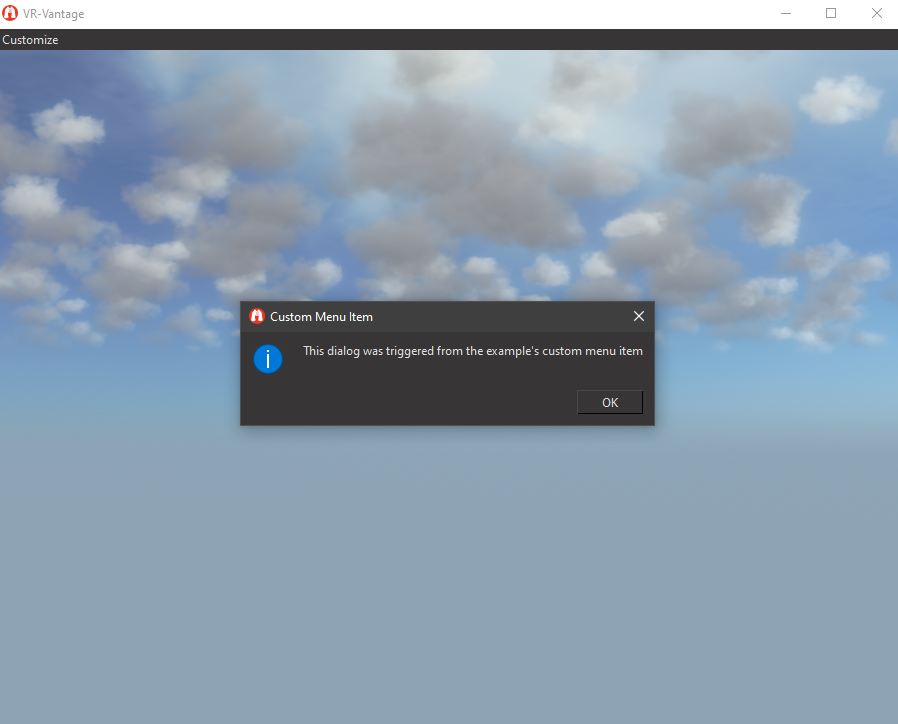
Say you want to use the existing VR-Vantage application but create your own menus, menu items and sub menu items. The example shows the simplest possible way to achieve this by registering custom menus with VR-Vantage. Once the menus are created, one can add their own logic to the GUI items.
The basic strategy here is let the DtVrvApplication do its thing, then just customize the way it looks. Let it load plug-ins, settings, data, etc. and then just what GUI elements are assembled right before the code that assembles the GUI executes. In this way, you get all the benefits of the plug-in architecture, but all the control of programatically created GUI.
The trick to doing that is to install an application transform, which is really just a function that gets called at a certain point. In this example we are going to install a function that gets called right after the plug-ins are loaded and before the GUI is assembled.
Here is the function we want to install. It's signature has to be the same as the DtVrvApplication::ApplicationTransform funtor:
We install the functor into the DtVrvApplication in main before the applications initialize method is called.
VR-Vantage includes pre-built versions of the example application. To build it yourself, follow the instructions at Building VR-Vantage Examples, Applications, and Plug-ins.
This example is a plug-in. You can run it by running vrvStealth.exe –plugin ../examples/plugins/release/exampleCustomMenu.dll (on Windows) or vrvStealth.exe –plugin ../examples/plugins/release/libexampleCustomMenu.so (on Linux) from the command prompt. Once the application is started, click on the "Customize" menu to see the popup. For more information about running examples, please see Running Applications and Examples.
[<< Examples] [Home] [Top of Page]