 |
VR-Link API Documentation for DIS
|
|
VR-Link API Documentation for DIS
|
The basic labeled argument that parses a value. More...
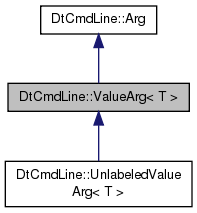
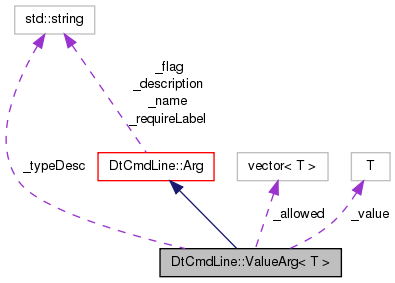
 Inheritance diagram for DtCmdLine::ValueArg< T >: Collaboration diagram for DtCmdLine::ValueArg< T >:
Public Member Functions | |
| ValueArg (const std::string &flag, const std::string &name, const std::string &desc, bool req, T value, const std::string &typeDesc, Visitor *v=NULL) | |
| Labeled ValueArg constructor. | |
| ValueArg (const std::string &flag, const std::string &name, const std::string &desc, bool req, T value, const std::string &typeDesc, CmdLineInterface &parser, Visitor *v=NULL) | |
| Labeled ValueArg constructor. | |
| ValueArg (const std::string &flag, const std::string &name, const std::string &desc, bool req, T value, const std::vector< T > &allowed, CmdLineInterface &parser, Visitor *v=NULL) | |
| Labeled ValueArg constructor. | |
| ValueArg (const std::string &flag, const std::string &name, const std::string &desc, bool req, T value, const std::vector< T > &allowed, Visitor *v=NULL) | |
| Labeled ValueArg constructor. | |
| virtual bool | processArg (int *i, std::vector< std::string > &args) |
| Handles the processing of the argument. | |
| const T & | getValue () const |
| Returns the value of the argument. | |
| T & | getValue () |
| Returns the value of the argument. | |
| void | setValue (const T &val) |
| sets The Value of the argument. | |
| T * | getInternalPtrValue () |
| Returns a pointer to the internal storage for this class This is useful for MTL and other not so smart readers. | |
| operator T & () | |
| allow for implicit conversion to my native type | |
| virtual std::string | shortID (const std::string &val="val") const |
| Specialization of shortID. | |
| virtual std::string | longID (const std::string &val="val") const |
| Specialization of longID. | |
| Public Member Functions inherited from DtCmdLine::Arg | |
| virtual | ~Arg () |
| Destructor. | |
| virtual void | addToList (std::list< Arg * > &argList) const |
| Adds this to the specified list of Args. | |
| virtual bool | operator== (const Arg &a) |
| Operator ==. | |
| const std::string & | getFlag () const |
| Returns the argument flag. | |
| const std::string & | getName () const |
| Returns the argument name. | |
| std::string | getDescription () const |
| Returns the argument description. | |
| virtual bool | isRequired () const |
| Indicates whether the argument is required. | |
| void | forceRequired () |
| Sets _required to true. | |
| void | xorSet () |
| Sets the _alreadySet value to true. | |
| bool | isValueRequired () const |
| Indicates whether a value must be specified for argument. | |
| bool | isSet () const |
| Indicates whether the argument has already been set. | |
| bool | isIgnoreable () const |
| Indicates whether the argument can be ignored, if desired. | |
| virtual bool | argMatches (const std::string &s) const |
| A method that tests whether a string matches this argument. | |
| virtual std::string | toString () const |
| Returns a simple string representation of the argument. | |
| virtual void | trimFlag (std::string &flag, std::string &value) const |
| Trims a value off of the flag. | |
| bool | _hasBlanks (const std::string &s) const |
| Checks whether a given string has blank chars, indicating that it is a combined SwitchArg. | |
| void | setRequireLabel (const std::string &s) |
| Sets the requireLabel. | |
Protected Member Functions | |
| void | _extractValue (const std::string &val) |
| Extracts the value from the string. | |
| void | _checkAllowed (const std::string &val) |
| Checks to see if parsed value is in allowed list. | |
| void | allowedInit () |
| Common initialization code for constructors with allowed vectors. | |
| Protected Member Functions inherited from DtCmdLine::Arg | |
| void | _checkWithVisitor () const |
| Performs the special handling described by the Vistitor. | |
| Arg (const std::string &flag, const std::string &name, const std::string &desc, bool req, bool valreq, Visitor *v=NULL) | |
| Primary constructor. | |
Protected Attributes | |
| T | _value |
| The value parsed from the command line. | |
| std::vector< T > | _allowed |
| A list of allowed values. | |
| std::string | _typeDesc |
| A human readable description of the type to be parsed. | |
| Protected Attributes inherited from DtCmdLine::Arg | |
| std::string | _flag |
| The single char flag used to identify the argument. | |
| std::string | _name |
| A single work namd indentifying the argument. | |
| std::string | _description |
| Description of the argument. | |
| bool | _required |
| Indicating whether the argument is required. | |
| std::string | _requireLabel |
| Label to be used in usage description. | |
| bool | _valueRequired |
| Indicates whether a value is required for the argument. | |
| bool | _alreadySet |
| Indicates whether the argument has been set. | |
| Visitor * | _visitor |
| A pointer to a vistitor object. | |
| bool | _ignoreable |
| Whether this argument can be ignored, if desired. | |
| bool | _xorSet |
| Indicates that the arg was set as part of an XOR and not on the command line. | |
Additional Inherited Members | |
| Static Public Member Functions inherited from DtCmdLine::Arg | |
| static void | beginIgnoring () |
| Begin ignoring arguments since the "–" argument was specified. | |
| static bool | ignoreRest () |
| Whether to ignore the rest. | |
| static char | delimiter () |
| The delimiter that separates an argument flag/name from the value. | |
| static const char | blankChar () |
| The char used as a place holder when SwitchArgs are combined. | |
| static const char | flagStartChar () |
| The char that indicates the beginning of a flag. | |
| static const std::string | flagStartString () |
| The sting that indicates the beginning of a flag. | |
| static const std::string | nameStartString () |
| The sting that indicates the beginning of a name. | |
| static const std::string | ignoreNameString () |
| The name used to identify the ignore rest argument. | |
| static void | setDelimiter (char c) |
| Sets the delimiter for all arguments. | |
The basic labeled argument that parses a value.
This is a template class, which means the type T defines the type that a given object will attempt to parse when the flag/name is matched on the command line. While there is nothing stopping you from creating an unflagged ValueArg, it is unwise and would cause significant problems. Instead use an UnlabeledValueArg.
| DtCmdLine::ValueArg< T >::ValueArg | ( | const std::string & | flag, |
| const std::string & | name, | ||
| const std::string & | desc, | ||
| bool | req, | ||
| T | value, | ||
| const std::string & | typeDesc, | ||
| Visitor * | v = NULL |
||
| ) |
Labeled ValueArg constructor.
You could conceivably call this constructor with a blank flag, but that would make you a bad person. It would also cause an exception to be thrown. If you want an unlabeled argument, use the other constructor.
| flag | - The one character flag that identifies this argument on the command line. |
| name | - A one word name for the argument. Can be used as a long flag on the command line. |
| desc | - A description of what the argument is for or does. |
| req | - Whether the argument is required on the command line. |
| value | - The default value assigned to this argument if it is not present on the command line. |
| typeDesc | - A short, human readable description of the type that this object expects. This is used in the generation of the USAGE statement. The goal is to be helpful to the end user of the program. |
| v | - An optional visitor. You probably should not use this unless you have a very good reason. |
| DtCmdLine::ValueArg< T >::ValueArg | ( | const std::string & | flag, |
| const std::string & | name, | ||
| const std::string & | desc, | ||
| bool | req, | ||
| T | value, | ||
| const std::string & | typeDesc, | ||
| CmdLineInterface & | parser, | ||
| Visitor * | v = NULL |
||
| ) |
Labeled ValueArg constructor.
You could conceivably call this constructor with a blank flag, but that would make you a bad person. It would also cause an exception to be thrown. If you want an unlabeled argument, use the other constructor.
| flag | - The one character flag that identifies this argument on the command line. |
| name | - A one word name for the argument. Can be used as a long flag on the command line. |
| desc | - A description of what the argument is for or does. |
| req | - Whether the argument is required on the command line. |
| value | - The default value assigned to this argument if it is not present on the command line. |
| typeDesc | - A short, human readable description of the type that this object expects. This is used in the generation of the USAGE statement. The goal is to be helpful to the end user of the program. |
| parser | - A CmdLine parser object to add this Arg to |
| v | - An optional visitor. You probably should not use this unless you have a very good reason. |
| DtCmdLine::ValueArg< T >::ValueArg | ( | const std::string & | flag, |
| const std::string & | name, | ||
| const std::string & | desc, | ||
| bool | req, | ||
| T | value, | ||
| const std::vector< T > & | allowed, | ||
| CmdLineInterface & | parser, | ||
| Visitor * | v = NULL |
||
| ) |
Labeled ValueArg constructor.
You could conceivably call this constructor with a blank flag, but that would make you a bad person. It would also cause an exception to be thrown. If you want an unlabeled argument, use the other constructor.
| flag | - The one character flag that identifies this argument on the command line. |
| name | - A one word name for the argument. Can be used as a long flag on the command line. |
| desc | - A description of what the argument is for or does. |
| req | - Whether the argument is required on the command line. |
| value | - The default value assigned to this argument if it is not present on the command line. |
| allowed | - A vector of type T that where the values in the vector are the only values allowed for the arg. |
| parser | - A CmdLine parser object to add this Arg to. |
| v | - An optional visitor. You probably should not use this unless you have a very good reason. |
| DtCmdLine::ValueArg< T >::ValueArg | ( | const std::string & | flag, |
| const std::string & | name, | ||
| const std::string & | desc, | ||
| bool | req, | ||
| T | value, | ||
| const std::vector< T > & | allowed, | ||
| Visitor * | v = NULL |
||
| ) |
Labeled ValueArg constructor.
You could conceivably call this constructor with a blank flag, but that would make you a bad person. It would also cause an exception to be thrown. If you want an unlabeled argument, use the other constructor.
| flag | - The one character flag that identifies this argument on the command line. |
| name | - A one word name for the argument. Can be used as a long flag on the command line. |
| desc | - A description of what the argument is for or does. |
| req | - Whether the argument is required on the command line. |
| value | - The default value assigned to this argument if it is not present on the command line. |
| allowed | - A vector of type T that where the values in the vector are the only values allowed for the arg. |
| v | - An optional visitor. You probably should not use this unless you have a very good reason. |
|
protected |
Checks to see if parsed value is in allowed list.
| val | - value parsed (only used in output). |
|
protected |
Extracts the value from the string.
Attempts to parse string as type T, if this fails an exception is thrown.
| val | - value to be parsed. |
|
protected |
Common initialization code for constructors with allowed vectors.
| T* DtCmdLine::ValueArg< T >::getInternalPtrValue | ( | ) |
Returns a pointer to the internal storage for this class This is useful for MTL and other not so smart readers.
Referenced by DtMtlEnvironment::registerCmdLineVar().
| const T& DtCmdLine::ValueArg< T >::getValue | ( | ) | const |
Returns the value of the argument.
| T& DtCmdLine::ValueArg< T >::getValue | ( | ) |
Returns the value of the argument.
|
virtual |
Specialization of longID.
| val | - value to be used. |
Reimplemented from DtCmdLine::Arg.
Reimplemented in DtCmdLine::UnlabeledValueArg< T >.
| DtCmdLine::ValueArg< T >::operator T & | ( | ) |
allow for implicit conversion to my native type
|
virtual |
Handles the processing of the argument.
This re-implements the Arg version of this method to set the _value of the argument appropriately. It knows the difference between labeled and unlabeled.
| i | - Pointer the the current argument in the list. |
| args | - Mutable list of strings. Passed in from main(). |
Implements DtCmdLine::Arg.
Reimplemented in DtCmdLine::UnlabeledValueArg< T >.
| void DtCmdLine::ValueArg< T >::setValue | ( | const T & | val | ) |
sets The Value of the argument.
|
virtual |
Specialization of shortID.
| val | - value to be used. |
Reimplemented from DtCmdLine::Arg.
Reimplemented in DtCmdLine::UnlabeledValueArg< T >.
|
protected |
A list of allowed values.
A list of values allowed for this argument. If the value parsed for this arg is not found in this list, then an exception is thrown. If the list is empty, then any value is allowed.
|
protected |
A human readable description of the type to be parsed.
This is a hack, plain and simple. Ideally we would use RTTI to return the name of type T, but until there is some sort of consistent support for human readable names, we are left to our own devices.
|
protected |
The value parsed from the command line.
Can be of any type, as long as the >> operator for the type is defined.