 |
VR-Link API Documentation for HLA Evolved
|


All Classes Namespaces Files Functions Variables Typedefs Enumerations Enumerator Friends Macros Groups Pages
|
VR-Link API Documentation for HLA Evolved
|
Used to set and maintain time in a simulation. More...
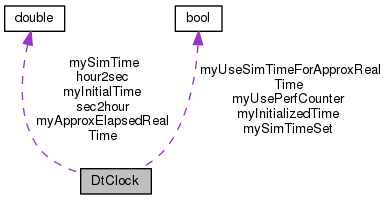
 Collaboration diagram for DtClock:
Public Member Functions | |
| DtClock () | |
| constructor calls init() More... | |
| DtClock (const DtClock &orig) | |
| copy constructor More... | |
| DtClock & | operator= (const DtClock &orig) |
| assignment operator More... | |
| virtual | ~DtClock () |
| destructor More... | |
| virtual void | init () |
| Initialize all VR-Link time object functionality. More... | |
| virtual DtTime | simTime () const |
| Get the current value of VR-Link's simulation time. More... | |
| virtual void | setSimTime (DtTime NewSimTime) |
| Set the current value of VR-Link simulation time. More... | |
| virtual bool | isSimTimeSet () const |
| Returns false if DtSetSimTime was never called and prints out warning message. More... | |
| virtual DtTime | elapsedRealTime () const |
| Return real seconds elapsed since DtTimeInit was called. More... | |
| virtual DtTime | approximateElapsedRealTime () const |
| Returns the value of getElapsedRealTime at the time that setSimTime was last invoked. More... | |
| virtual bool | useSimTimeForApproxRealTime () const |
| Check whether myUseSimTimeForApproxRealTime is set. More... | |
| virtual void | setUseSimTimeForApproxRealTime () |
| Set/Clear whether simTime should be used to approximate the real time for the method approximateElapsedRealTime(). More... | |
| virtual void | clearUseSimTimeForApproxRealTime () |
| virtual DtTime | absRealTime () const |
| Return current wall-clock time - seconds since Jan 1, 1970. More... | |
| void | setUsePerfCounter (bool val) |
| In windows this enables the high performance counter which allows for better than millisecond counts but is more processor intensive. More... | |
| bool | usePerfCounter () const |
Static Public Attributes | |
| static const double | hour2sec |
| Clock constants used for time conversions. More... | |
| static const double | sec2hour |
Protected Attributes | |
| DtTime | myInitialTime |
| Save starting time to subtract from current to get elapsed. More... | |
| DtTime | mySimTime |
| This is the internal vr-link simulation clock. More... | |
| DtTime | myApproxElapsedRealTime |
| This is the Elapsed Real Time at the point that SetSimTime() is called. More... | |
| bool | mySimTimeSet |
| bool | myUseSimTimeForApproxRealTime |
| Flag to change meaning of approximate real time. More... | |
| bool | myUsePerfCounter |
| bool | myInitializedTime |
Used to set and maintain time in a simulation.
| DtClock::DtClock | ( | ) |
constructor calls init()
| DtClock::DtClock | ( | const DtClock & | orig | ) |
copy constructor
|
virtual |
destructor
|
virtual |
Return current wall-clock time - seconds since Jan 1, 1970.
|
virtual |
Returns the value of getElapsedRealTime at the time that setSimTime was last invoked.
|
virtual |
|
virtual |
Return real seconds elapsed since DtTimeInit was called.
|
virtual |
Initialize all VR-Link time object functionality.
This must be called before any other time-related functions.
|
virtual |
Returns false if DtSetSimTime was never called and prints out warning message.
|
virtual |
Set the current value of VR-Link simulation time.
Should be called once per simulation frame to let VR-Link know the value of simulation time for the frame.
|
inline |
In windows this enables the high performance counter which allows for better than millisecond counts but is more processor intensive.
In Linux, this value does nothing.
|
virtual |
Set/Clear whether simTime should be used to approximate the real time for the method approximateElapsedRealTime().
|
virtual |
Get the current value of VR-Link's simulation time.
|
inline |
|
virtual |
Check whether myUseSimTimeForApproxRealTime is set.
|
static |
Clock constants used for time conversions.
|
protected |
This is the Elapsed Real Time at the point that SetSimTime() is called.
It is good enough for timeouts, and is a LOT cheaper than getting the exact real time, which is overkill.
|
protected |
|
protected |
Save starting time to subtract from current to get elapsed.
|
protected |
This is the internal vr-link simulation clock.
|
protected |
|
protected |
|
protected |
Flag to change meaning of approximate real time.
|
static |