 |
VR-Vantage 3.1.1 API Documentation
|


All Classes Namespaces Files Functions Variables Typedefs Enumerations Enumerator Properties Friends Macros Groups Pages
|
VR-Vantage 3.1.1 API Documentation
|
OpenSceneGraph is a C++ scene graph API built on top of OpenGL.
A scene graph is a data structure that represents a scene through connected nodes. OSG follows a number of common patterns for interoperating with the scene. One example is the visitor pattern in which an object is written in a way that allows it to visit each node in a graph and perform an operation such as culling. OSG provides many features that VRVantage can support, including a wide range of file format loaders, particle effects, weather, data management, paging data, and LOD management. If VR-Vantage does not support a particular OSG feature, it can be integrated with minimal effort. OSG provides plug-ins for additional capabilities and file loading. VR-Vantage provides plug-ins for loading MAK GDB files, MAK propriety geometry (MEDF), and imagery (MEIF) files.
The scene graph starts with a top level root node. Beneath the root node, group nodes organize geometry, transforms, and state. The figure below represents an abstract scene graph.
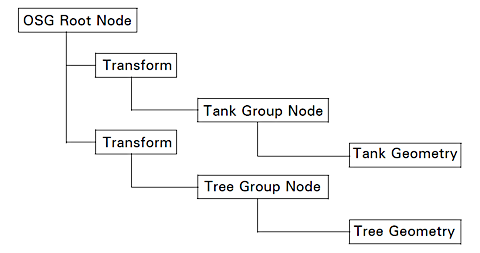
We've provided some simple OSG only examples that will help you learn the OSG Layer API if you need work with the scene graph directly.

| exampleOsgSimple - Shows how to create a simple OpenSceneGraph application that mimics exampleOpenGLSimple by displaying a cube. |

| exampleOsgTransforms - Shows how to create a simple OpenSceneGraph application that mimics exampleOpenGLTransforms by creating and transforming several geometry objects. |

| exampleOsgArticulation - Shows how to create a simple OpenSceneGraph application that loads a geometry file from disk, locates degree-of-freedom nodes in the geometry and articulate the geometry with those nodes. |
[<< The OpenGL Layer] [Home] [Top of Page] [The Rendering System Layer >>]