 |
VR-Forces 4.8 Class Documentation
|


All Classes Namespaces Files Functions Variables Typedefs Enumerations Enumerator Properties Friends Macros Groups Pages
|
VR-Forces 4.8 Class Documentation
|
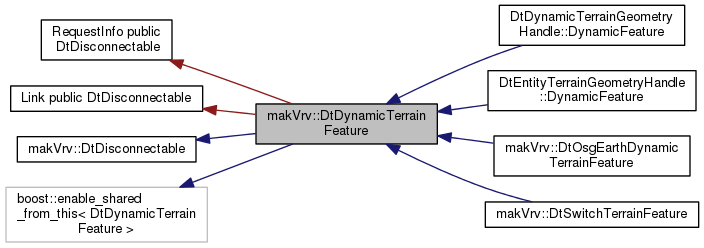
Interface which abstracts the concept of a individually identifiable "thing" in the terrain. More...
Classes | |
| class | RequestHandle |
| Resource handle for a change request which has been added to the system. More... | |
Public Member Functions | |
| DtDynamicTerrainFeature () | |
| Default Constructor. More... | |
| virtual | ~DtDynamicTerrainFeature () |
| Virtual destructor. More... | |
| virtual bool | matches (const DtDynamicTerrainChange &, bool useOriginalGeometry=false) const =0 |
| Matching functions. More... | |
| virtual bool | matches (const DtDynamicTerrainGeometry &, bool useOriginalGeometry=false) const =0 |
| virtual const DtDynamicTerrainGeometry * | geometry () const =0 |
| Geometry which represents this feature. More... | |
| virtual const DtDynamicTerrainGeometry * | originalGeometry () const |
| Unprocessed geometry. More... | |
| virtual boost::optional< DtString > | featureAttribute (const DtString &key) const |
| Access attribute values encoded into features. More... | |
| virtual bool | isInDefaultState () const =0 |
| Is this feature in it's default (i.e. unchanged) state? More... | |
| virtual bool | lastStateWasDefaultState () const =0 |
| Was the previous state the feature was in immediately before the current state the default state? More... | |
| virtual void | changeState (const DtDynamicTerrainChanges &history)=0 |
| Called by the dynamic terrain system in order to notify a feature that it should change its state. More... | |
| virtual void | iterateCommands (const boost::function< void(const DtDynamicTerrainChange &)> &callback) const |
| Call the supplied callback on commands which represent the commands a feature can respond to. More... | |
| virtual void | iterateCommands (const boost::function< void(const DtDynamicTerrainChange &)> &callback, const DtString &key) const |
| void | changed () |
| Calls changeState and all attached query callbacks. More... | |
| bool | pageOut () |
| Remove all change requests links and remove feature from dynamic terrain world. More... | |
| void | changes (const boost::function< void(const DtDynamicTerrainChanges &)> &callback) const |
| Calls supplied callback on this features DtDynamicTerrainChanges interface. More... | |
| RequestHandle | addChangeRequest (DtDynamicTerrainChange *change) |
| Add a change request directly to this feature. More... | |
| RequestHandle | addChangeRequest (double time, DtDynamicTerrainChange *change) |
| virtual | ~Link () |
| RequestInfo & | request () |
| DtDynamicTerrainFeature & | feature () |
| RequestInfo (DtDynamicTerrainChange *command) | |
| virtual | ~RequestInfo () |
| const DtDynamicTerrainChange & | command () const |
| void | pageOut () |
| virtual DtString | description () const =0 |
| Feature description functions Allows feature to describe itself (for a gui mostly). More... | |
| virtual const DtDynamicTerrainFeature * | parentFeature () const |
 Public Member Functions inherited from makVrv::DtDisconnectable Public Member Functions inherited from makVrv::DtDisconnectable | |
| DtDisconnectable () | |
| Default constructor. More... | |
| virtual | ~DtDisconnectable () |
| Destructor. More... | |
| virtual boost::signals2::connection | addDisconnectFunction (const boost::function< void()> &callback) |
| Add a function to be called when callDisconnectFunctions is called. More... | |
| virtual bool | callDisconnectFunctions () |
| Atomically call all the disconnect functions and mark this object as disconnected. More... | |
Static Public Member Functions | |
| static unsigned long long | GetObjectCount () |
| static unsigned long long | GetObjectCount () |
| static bool | Create (const boost::shared_ptr< DtDynamicTerrainFeature > &featureInfo, const boost::shared_ptr< RequestInfo > &reqInfo) |
| static unsigned long long | GetObjectCount () |
Protected Member Functions | |
| virtual void | removeTerrainChange (const DtDynamicTerrainChange &change) |
| This method is called when a change is removed. More... | |
| void | indexDoubleAscending (const DtString &key) |
| Key/value attribute indexing. More... | |
| void | indexDoubleDescending (const DtString &key) |
| void | indexIntAscending (const DtString &key) |
| void | indexIntDescending (const DtString &key) |
| void | indexStringAscending (const DtString &key) |
| void | indexStringDescending (const DtString &key) |
| void | setupIndex (const DtString &key, DtDynamicTerrainIndex *index) |
Private Types | |
| typedef boost::signals2::signal< void(const DtDynamicTerrainFeature &)> | Signal |
| typedef boost::signals2::signal< > | ChangeSignal |
| typedef std::map< RequestInfo *, boost::shared_ptr< Link > > | LinkInfoMap |
| typedef tbb::spin_rw_mutex | Mutex |
| typedef std::map< DtString, DtDynamicTerrainIndex * > | IndexMap |
| typedef std::list < boost::shared_ptr< Link > > | LinkList |
| typedef tbb::spin_mutex | Mutex |
Private Member Functions | |
| Link (const boost::shared_ptr< DtDynamicTerrainFeature > &featureInfo, const boost::shared_ptr< RequestInfo > &reqInfo) | |
| void | makeLinkToFeature (const boost::shared_ptr< Link > &link) |
| void | breakLinkToFeature (LinkList::iterator i) |
| bool | makeLinkToRequest (const boost::shared_ptr< Link > &link) |
| functions for creating and breaking the links More... | |
| virtual void | breakLinkToRequest (LinkInfoMap::iterator) |
Private Attributes | |
| ChangeSignal | myChangeSignal |
| Signal | myPageOutSignal |
| Mutex | myMutex |
| LinkInfoMap | myLinkMap |
| IndexMap | myIndices |
| const boost::shared_ptr < RequestInfo > | myRequestInfo |
| const boost::shared_ptr < DtDynamicTerrainFeature > | myFeatureInfo |
| boost::scoped_ptr < DtDynamicTerrainChange > | myCommand |
| LinkList | myLinksToFeatures |
Friends | |
| class | Link |
| typedef boost::function< void(const DtDynamicTerrainFeature &)> | Callback |
| Signal notification. More... | |
| typedef boost::function< void(const DtDynamicTerrainFeature &, const DtDynamicTerrainChanges &)> | ChangeCallback |
| virtual boost::signals2::connection | connectToChangeSignal (const ChangeCallback &callback) const |
| Call callback when feature state is changed. More... | |
| virtual boost::signals2::connection | connectToPageOutSignal (const Callback &callback) const |
| Call callback when feature is removed. More... | |
Additional Inherited Members | |
| Protected Types inherited from makVrv::DtDisconnectable | |
| enum | State { NotUsed, InUse, Disconnected } |
| typedef tbb::spin_mutex | Mutex |
| Protected Attributes inherited from makVrv::DtDisconnectable | |
| Mutex | myMutex |
| State | myDisconnectedState |
| boost::signals2::signal< void()> | myDisconnectSignal |
Interface which abstracts the concept of a individually identifiable "thing" in the terrain.
This is the object which must be implemented in order to add new kinds of terrain to the dynamic terrain system. While features are generally dynamic (that is, they have something about them that can be changed through this interface) they do not have to be and features which do not respond to changes can be added in order to found during querying.
The terrain world deciding the change the state of a feature causes it to call the changeState function on the feature and pass in a history interface which allows the feature to view the history time line of events (change requests) which are currently affecting this feature. This is generally allows the feature to view every piece of data it needs in order to faithfully reconstruct the terrain from whatever state it is in. The ordering of this history is the only thing the terrain world uses the change request times for.
Features respond to a combination of a command (DtDynamicTerrainChange) and a geometry (DtDynamicTerrainGeometry). DtDynamicTerranCommand is an interface into a key/value dictionary, the keys are strings and values can be strings, doubles, ints, or bools. The terrain world (DtDynamicTerrainWorld, which manages the features) never actually calls any of the command member functions, only the features themselves. In this way drivers (writers of code that inserts change requests or code that inserts features) only need to agree amongst themselves about what the commands mean. This allows the features to respond to a wide varied of commands. Simple features like switch nodes and DOF nodes can respond to direct commands (i.e. state=1 or rotation=90) or they can use configuration to respond to higher levels commands (i.e. damage=true or state=open), or (and most importantly for the simulation) they can respond to generic events (i.e. event=explosion,force=50 or event=ditch,width=10).
The geometry object is allows feature implementations which can construct terrain dynamically to access the geometry of the request (i.e. to create an odd shaped ditch) which features which don't have those abilities can ignore it. A null geometry pointer is considered to match all other geometries.
Features are added to the terrain world when terrain is paged in and the terrain world takes ownership of them. Features are removed from the terrain world when the terrain is paged out by calling functions in the handles returned by the terrain world when the feature was added.
There does not have to be a one to one relationship between features and whatever objects implement the terrain dynamics. Features are designed such that each one can represent a very small or very large part of the terrain. They can represent something like a single switch node, in which case a terrain may add many thousands of features, or a single feature can be used to encapsulate an entire terrain layer.
| typedef boost::function<void (const DtDynamicTerrainFeature&)> makVrv::DtDynamicTerrainFeature::Callback |
Signal notification.
The functions can be used to install callbacks which are called when events happen. These changes will be called from inside the call that makes the change.
| typedef boost::function<void (const DtDynamicTerrainFeature&, const DtDynamicTerrainChanges&)> makVrv::DtDynamicTerrainFeature::ChangeCallback |
|
private |
|
private |
|
private |
|
private |
|
private |
|
private |
|
private |
| makVrv::DtDynamicTerrainFeature::DtDynamicTerrainFeature | ( | ) |
Default Constructor.
|
virtual |
Virtual destructor.
|
virtual |
|
virtual |
|
pure virtual |
Matching functions.
Allow for arbitrary matching against requests, queries, and spatial index subspaces. Setting useOriginalGeometry will match against the geometry without any changes made by this system (i.e. uses the original geometry obtained from the parser).
Implemented in DtEntityTerrainGeometryHandle::DynamicFeature, makVrv::DtOsgEarthDynamicTerrainFeature, makVrv::DtSwitchTerrainFeature, and DtDynamicTerrainGeometryHandle::DynamicFeature.
|
pure virtual |
|
pure virtual |
Geometry which represents this feature.
Implemented in DtEntityTerrainGeometryHandle::DynamicFeature, makVrv::DtOsgEarthDynamicTerrainFeature, makVrv::DtSwitchTerrainFeature, and DtDynamicTerrainGeometryHandle::DynamicFeature.
|
virtual |
Unprocessed geometry.
Reimplemented in DtEntityTerrainGeometryHandle::DynamicFeature, makVrv::DtSwitchTerrainFeature, and DtDynamicTerrainGeometryHandle::DynamicFeature.
|
virtual |
Access attribute values encoded into features.
|
pure virtual |
Is this feature in it's default (i.e. unchanged) state?
Implemented in makVrv::DtOsgEarthDynamicTerrainFeature, DtEntityTerrainGeometryHandle::DynamicFeature, makVrv::DtSwitchTerrainFeature, and DtDynamicTerrainGeometryHandle::DynamicFeature.
|
pure virtual |
Was the previous state the feature was in immediately before the current state the default state?
Implemented in makVrv::DtOsgEarthDynamicTerrainFeature, DtEntityTerrainGeometryHandle::DynamicFeature, makVrv::DtSwitchTerrainFeature, and DtDynamicTerrainGeometryHandle::DynamicFeature.
|
pure virtual |
Called by the dynamic terrain system in order to notify a feature that it should change its state.
The history is an interface into the all of the terrain state changes. This function may be called concurrently from multiple threads.
| history | History interface. |
Implemented in DtEntityTerrainGeometryHandle::DynamicFeature, makVrv::DtOsgEarthDynamicTerrainFeature, makVrv::DtSwitchTerrainFeature, and DtDynamicTerrainGeometryHandle::DynamicFeature.
|
virtual |
Call callback when feature state is changed.
Called immediately after changeState is called. This function may be called concurrently from multiple threads.
| callback | function object to be called. |
| Connection | object which can be used to disconnect the connection. |
|
virtual |
Call callback when feature is removed.
The callback will only be called once.
| callback | function object to be called. |
| Connection | object which can be used to disconnect the connection. |
|
pure virtual |
Feature description functions Allows feature to describe itself (for a gui mostly).
These can all be called from query callbacks. None of the values returned by these functions have any meaning besides informational. A description of what is in the feature, how it is setup, configuration, etc.
Implemented in DtEntityTerrainGeometryHandle::DynamicFeature, makVrv::DtOsgEarthDynamicTerrainFeature, makVrv::DtSwitchTerrainFeature, and DtDynamicTerrainGeometryHandle::DynamicFeature.
|
virtual |
Reimplemented in makVrv::DtSwitchTerrainFeature.
|
virtual |
Call the supplied callback on commands which represent the commands a feature can respond to.
This function is designed to be called from a query callback. The purpose of this function is supply a gui or other introspective tool with commands to issue (possibly modified) to this feature or to the terrain. A feature should create commands which they could respond to and would cause them to set themselves to the state they are in now. If there is some command a feature can respond to, outputting it in this function will allow a gui to do things like automatically create a menu with all the possibilities. The commands know the types of the attributes they contain, so the gui will know how to edit the values correctly in order to let the user change the commands before they are issued.
Reimplemented in makVrv::DtOsgEarthDynamicTerrainFeature, DtEntityTerrainGeometryHandle::DynamicFeature, and DtDynamicTerrainGeometryHandle::DynamicFeature.
|
virtual |
Reimplemented in makVrv::DtSwitchTerrainFeature.
| void makVrv::DtDynamicTerrainFeature::changed | ( | ) |
Calls changeState and all attached query callbacks.
| bool makVrv::DtDynamicTerrainFeature::pageOut | ( | ) |
Remove all change requests links and remove feature from dynamic terrain world.
| true | if feature was paged out in this call, false otherwise. |
| void makVrv::DtDynamicTerrainFeature::changes | ( | const boost::function< void(const DtDynamicTerrainChanges &)> & | callback | ) | const |
Calls supplied callback on this features DtDynamicTerrainChanges interface.
Use this function to observer the current state of a feature.
| RequestHandle makVrv::DtDynamicTerrainFeature::addChangeRequest | ( | DtDynamicTerrainChange * | change | ) |
Add a change request directly to this feature.
| RequestHandle makVrv::DtDynamicTerrainFeature::addChangeRequest | ( | double | time, |
| DtDynamicTerrainChange * | change | ||
| ) |
|
protected |
Key/value attribute indexing.
Non-virtual because these functions should be called from subclass constructors.
|
protected |
|
protected |
|
protected |
|
protected |
|
protected |
|
protected |
|
protectedvirtual |
This method is called when a change is removed.
The default behavior is to do nothing, as for some features, all the changes are removed at once and the feature can just reset based on an empty change list. But some features need to actually see the change being removed and it's data so they can respond appropriately (like removing a change that added a visual such as a crater from some arbitrary place in the current change list
Reimplemented in makVrv::DtOsgEarthDynamicTerrainFeature.
|
private |
functions for creating and breaking the links
|
privatevirtual |
|
static |
|
inline |
|
inline |
|
private |
|
explicit |
| const DtDynamicTerrainChange& makVrv::DtDynamicTerrainFeature::command | ( | ) | const |
| void makVrv::DtDynamicTerrainFeature::pageOut | ( | ) |
|
private |
|
private |
|
friend |
|
mutableprivate |
|
mutableprivate |
|
mutableprivate |
|
private |
|
private |
|
private |
|
private |
|
private |
|
private |