 |
VR-Forces 4.8 Class Documentation
|


All Classes Namespaces Files Functions Variables Typedefs Enumerations Enumerator Properties Friends Macros Groups Pages
|
VR-Forces 4.8 Class Documentation
|
VR-Forces includes an aggregate model for simulating the organization of entities in a hierarchical command structure.
The aggregate entities in VR-Forces are multi-resolution models. Their components enable them to be simulated in either of two states:
Aggregates in VR-Forces share certain common elements. An aggregate in VR-Forces is always configured with the following:
Aggregates are also always configured with a DtVrfRadio, which enables radio-like communication between entities in the same unit.
Aggregates also typically specify a list of subordinate entities to create when the aggregate entity gets created. Each entry in the list specifies the DIS/RPR FOM entity type of the subordinate to create, and its initial position and heading. The following code is the subordinate list of the Armor Plt (US):
Aggregates may have individual (platform-level) subordinates, aggregate subordinates, or a combination of both.
Aggregates share many of the same systems and simulation components (sensors, controllers, and actuators). To examine the systems typically configured on an aggregate, we'll look at a specific instance of an aggregate, the Armor Plt (US) entity.
It is a representative example that includes all of the common systems and components that make up an aggregate. The differences between the various types of aggregates supported in VR-Forces arise from the types of subordinates a given aggregate is configured with, and the parameter values used in configuring certain behaviors, such as moving in formation.
Defined in parameter files Aggregate.ope and Armor_Plt_(US).entity..
The figure below shows which systems and simulation components are configured as part of an Armor platoon. The boxes (nodes) represent either a system of components (DtComponentSystem) or indivdiual DtSimComponent classes.
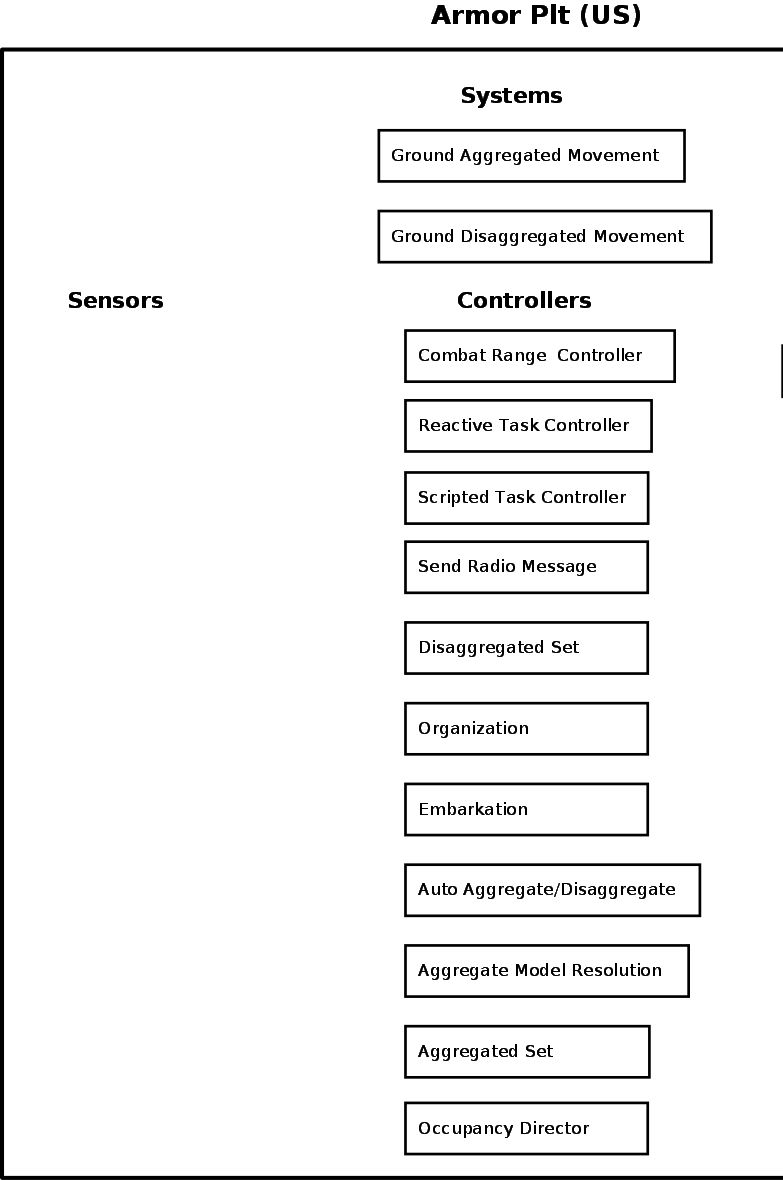
Individual DtSimComponents (not organized as part of a system) that make up the rest of entity:
There are no sensors configured as part of this aggregate.
Disaggregated Damage (DtDisaggregatedDamageActuator) – Models damage of aggregate (disaggreated state only).
[<< The Missile Entity Behavior Model] [Home] [Top of Page] [Ground Vehicle Kinematics Model >>]