 |
VR-Link API Documentation for DIS
|
|
VR-Link API Documentation for DIS
|
An abstract base class to represent a Socket Type. More...
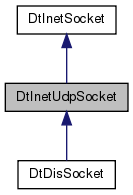
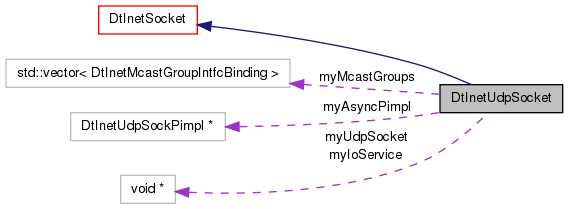
 Inheritance diagram for DtInetUdpSocket: Collaboration diagram for DtInetUdpSocket:
Public Member Functions | |
| DtInetUdpSocket () | |
| Default Constructor. | |
| DtInetUdpSocket (const DtInetEndpoint &dest, DtU16 localPort=0, DtInetDevice *hostIf=NULL, DtU32 flags=DtDefaultSockOpts, bool immediateOpen=true) | |
| Client Socket Constructor. | |
| virtual | ~DtInetUdpSocket () |
| Destructor. | |
| virtual bool | setDestination (const DtInetEndpoint &dest) |
| Set / get the destination endpoint for the socket. | |
| virtual bool | openSocket () |
| Enable sending and receiving of packets. | |
| virtual bool | closeSocket () |
| Close a socket. | |
| virtual bool | bindToDevice (const DtInetDevice *hostIf=NULL) |
| Set the network interface device the socket will attempt to bind to on the local host. | |
| virtual bool | connectToDestination () |
| Initiate a connection to a single unicast destination endpoint. | |
| virtual bool | disconnect () |
| Dissolve any unicast connection and return to normal 'connectionless' operation. | |
| virtual bool | isOk () |
| Deprecated. | |
| virtual int | descriptor () const |
| Get the socket's descriptor. | |
| virtual bool | setSocket (const DtInetEndpoint &dest, DtU16 localPort=0, DtInetDevice *hostIf=NULL, DtU32 flags=DtDefaultSockOpts) |
| Set all socket parameters at once. | |
| virtual void * | udpSocket () |
| Return the underlying socket object. | |
Send methods. | |
Use send() or sendChain() to write to the socket's default destination endpoint, whether the socket is in CONNECTED state or not. Use sendTo() or sendChainTo() on unconnected sockets to send to any endpoint, including the default destination, by specifying the endpoint in 'dest'. If sendTo() or sendChainTo() is used on a socket in the CONNECTED the destination endpoint will be ignored and the packet will be sent to the default destination. Return the number of bytes sent or -1 if an error occurs. Use getLastError() and getLastErrorString() to retrieve cause of failure. | |
| virtual int | send (caddr_t packet, size_t size, DtU32 flags=0) |
| Simple send methods. | |
| virtual int | sendTo (caddr_t packet, size_t size, DtInetEndpoint &dest, DtU32 flags=0) |
| Simple send methods. | |
| virtual int | sendChain (DtInetBufferChain &packets, DtU32 flags=0) |
| Send from a chain of buffers. | |
| virtual int | sendChainTo (DtInetBufferChain &packets, DtInetEndpoint &dest, DtU32 flags=0) |
| Simple send methods. | |
Receive methods. | |
If the socket is in the CONNECTED state it will only receive packets from the designated connected host regardless of the receive method invoked. Return a status code if an error occurs or if the received packet was discarded by packet filtering. If packet filtering is enabled this method may return empty buffers. Otherwise the number of bytes received is returned in which case the return value should be cast to an integer type. If an error occurs use getLastError() and getLastErrorString() to retrieve the cause of the failure. | |
| virtual DtInetSockRcvStatus | recv (caddr_t buff, size_t buffSize, DtU32 flags=0) |
| Simple receive method. | |
| virtual DtInetSockRcvStatus | recvToChain (DtInetBufferChain &packets, DtU32 flags=0) |
| Receives into a buffer chain. | |
| virtual DtInetSockRcvStatus | recvFrom (caddr_t buff, size_t buffSize, DtInetEndpoint &src, DtU32 flags=0) |
| Same as above, but sets 'src' to reflect peer from which the packet was received. | |
| virtual DtInetSockRcvStatus | recvToChainFrom (DtInetBufferChain &packets, DtInetEndpoint &src, DtU32 flags=0) |
| Simple receive method. | |
Set / get socket options. | |
These methods provides an interface to all supported socket options. The socket must be open in order to use these methods. | |
| virtual bool | setNonBlockingOption (bool onOrOff) |
| virtual bool | setSendBufferSize (DtU32 size) |
| virtual bool | setReceiveBufferSize (DtU32 size) |
| virtual bool | setBroadcastOption (bool onOrOff) |
| virtual bool | setReuseAddressOption (bool onOrOff) |
| virtual bool | setDoNotRouteOption (bool onOrOff) |
| virtual bool | setSendLowWatermark (DtU32 size) |
| virtual bool | setReceiveLowWatermark (DtU32 size) |
| virtual bool | setMcastDevice (const DtInetAddr &devAddr) |
| virtual bool | setMcastDevice (DtInetDevice *hostIf) |
| virtual DtU32 | getSendBufferSize () |
| virtual DtU32 | getReceiveBufferSize () |
| virtual DtU32 | getBytesAvailable () |
| virtual bool | getBroadcastOption () |
| virtual bool | getReuseAddressOption () |
| virtual bool | getDoNotRouteOption () |
| virtual DtU32 | getSendLowWatermark () |
| virtual DtU32 | getReceiveLowWatermark () |
Multicast specific methods. | |
Join / drop subscription to multicast group. Socket will join group identified by the multicast address in grpAddr or grpEndpoint. If an object is passed in the port value of the endpoint will be ignored and the socket will join from the same port the socket's local endpoint uses. If no interface is specified in the join it will join on the host's default multicast interface. | |
| virtual bool | joinMulticastGroup (const DtInetAddr &grpAddr, DtInetDevice *device=NULL) |
| Change the default time-to-live on outbound multicast packets sent from this socket. | |
| virtual bool | joinMulticastGroup (const DtInetEndpoint &grpEndpoint, DtInetDevice *device=NULL) |
| Change the default time-to-live on outbound multicast packets sent from this socket. | |
| virtual bool | dropMulticastGroup (const DtInetAddr &grpAddr, DtInetDevice *device=NULL) |
| Change the default time-to-live on outbound multicast packets sent from this socket. | |
| virtual bool | dropMulticastGroup (const DtInetEndpoint &grpEndpoint, DtInetDevice *device=NULL) |
| Change the default time-to-live on outbound multicast packets sent from this socket. | |
| virtual bool | setMcastTtlOption (DtU32 ttl) |
| Change the default time-to-live on outbound multicast packets sent from this socket. | |
Protected Types | |
| typedef std::pair< DtInetAddr, DtInetAddr > | DtInetMcastGroupIntfcBinding |
| Associate the multicast group address with the host interface address the group is joined from. | |
| typedef std::vector < DtInetMcastGroupIntfcBinding > | DtInetMcastGroupBindings |
Protected Attributes | |
| void * | myIoService |
| void * | myUdpSocket |
| DtInetMcastGroupBindings | myMcastGroups |
Private Member Functions | |
| DtInetUdpSocket (const DtInetUdpSocket &orig) | |
| Copy constructor not implemented. | |
| DtInetUdpSocket & | operator= (const DtInetUdpSocket &orig) |
| Assignment not implemented. | |
Private Attributes | |
| DtInetUdpSockPimpl * | myAsyncPimpl |
Friends | |
| class | DtInetUdpSockPimpl |
| For async operations. | |
An abstract base class to represent a Socket Type.
typedef std::vector<DtInetMcastGroupIntfcBinding> DtInetUdpSocket::DtInetMcastGroupBindings [protected] |
typedef std::pair<DtInetAddr, DtInetAddr> DtInetUdpSocket::DtInetMcastGroupIntfcBinding [protected] |
Associate the multicast group address with the host interface address the group is joined from.
Default Constructor.
| DtInetUdpSocket::DtInetUdpSocket | ( | const DtInetEndpoint & | dest, |
| DtU16 | localPort = 0, |
||
| DtInetDevice * | hostIf = NULL, |
||
| DtU32 | flags = DtDefaultSockOpts, |
||
| bool | immediateOpen = true |
||
| ) |
Client Socket Constructor.
Takes a DtInetEndpoint (containing the destination address, protocol (must be UDP), and destination port number), a source port number to use, a pointer to the local network interface device the socket will be bound to, socket option flags, and an 'immediateOpen' indicator dictating how the socket should behave upon creation. The address family (IPv4 or IPv6) is assumed from the destin- ation endpoint object. If the specified local port is 0 an ephemeral port will be chosen for the connection UNLESS the destination is a broadcast or multicast address, in which case the destination port is used as the local port also. If no host interface is specified the most appropriate interface will be chosen based on the destination. If the destination endpoint specifies a multicast address the multicast group is joined automatically when the socket is opened and the group member- ship is dropped when the socket is closed. If the 'immediateOpen' parameter is true the socket will immediately try to bind to an interface and allow datagrams to be sent and received using the default packet handlers which perform no parsing of packets. To use custom packet handlers for the send and receive functions set 'immediateOpen' to false, configure the packet handler callbacks, then call openSocket() or connectToDestination() if the socket will only communicate with a single remote host. This ctor will not throw exceptions on failure. Check the socket status by calling state() (or isOk()) to determine if the socket is ready.
| virtual DtInetUdpSocket::~DtInetUdpSocket | ( | ) | [virtual] |
Destructor.
| DtInetUdpSocket::DtInetUdpSocket | ( | const DtInetUdpSocket & | orig | ) | [private] |
Copy constructor not implemented.
| virtual bool DtInetUdpSocket::bindToDevice | ( | const DtInetDevice * | hostIf = NULL | ) | [virtual] |
Set the network interface device the socket will attempt to bind to on the local host.
The actual bind takes place after the socket is opened. If hostIf is NULL the socket will bind to the first device with an assigned IP address that most closely matches the destination endpoint family and prefix. If the socket's destination endpoint specifies a broadcast address the socket will bind to the specified interface's default broadcast address even if it does not match the broadcast address in the destination endpoint (ie. it's idiot-proof). Returns true on success and false on failure. Call getLastError() and getLastErrorString() to retrieve cause of failure.
Implements DtInetSocket.
| virtual bool DtInetUdpSocket::closeSocket | ( | ) | [virtual] |
Close a socket.
Returns true on successful close or false on failure. Call getLastError() and getLastErrorString() to retrieve cause of failure.
Implements DtInetSocket.
Reimplemented in DtDisSocket.
| virtual bool DtInetUdpSocket::connectToDestination | ( | ) | [virtual] |
Initiate a connection to a single unicast destination endpoint.
For UDP sockets this precludes sending and receiving broadcast and multicast while the socket is connected. It is not necessary to call connectToDestination() for normal UDP socket communication with multiple hosts or when performing broadcast or multicast send / receive. The destination can be changed at will on UDP sockets by calling setDestination() and connectToDestination() in succession. The socket state will be set to CONNECTED to indicate the socket is only communicating with one destination endpoint. To dissolve a connection (eg. communicate with more than one host at will) use disconnect(). The state will be set to OPEN when the connection is dissolved. Since there is no handshaking to confirm that communication with the destination is possible this method always returns true unless an error occurs. Call getLastError() and getLastErrorString() to retrieve the cause of the failure.
Implements DtInetSocket.
| virtual int DtInetUdpSocket::descriptor | ( | ) | const [virtual] |
Get the socket's descriptor.
Implements DtInetSocket.
| virtual bool DtInetUdpSocket::disconnect | ( | ) | [virtual] |
Dissolve any unicast connection and return to normal 'connectionless' operation.
| virtual bool DtInetUdpSocket::dropMulticastGroup | ( | const DtInetAddr & | grpAddr, |
| DtInetDevice * | device = NULL |
||
| ) | [virtual] |
Change the default time-to-live on outbound multicast packets sent from this socket.
| virtual bool DtInetUdpSocket::dropMulticastGroup | ( | const DtInetEndpoint & | grpEndpoint, |
| DtInetDevice * | device = NULL |
||
| ) | [virtual] |
Change the default time-to-live on outbound multicast packets sent from this socket.
| virtual bool DtInetUdpSocket::getBroadcastOption | ( | ) | [virtual] |
| virtual DtU32 DtInetUdpSocket::getBytesAvailable | ( | ) | [virtual] |
Implements DtInetSocket.
| virtual bool DtInetUdpSocket::getDoNotRouteOption | ( | ) | [virtual] |
Implements DtInetSocket.
| virtual DtU32 DtInetUdpSocket::getReceiveBufferSize | ( | ) | [virtual] |
Implements DtInetSocket.
| virtual DtU32 DtInetUdpSocket::getReceiveLowWatermark | ( | ) | [virtual] |
Implements DtInetSocket.
| virtual bool DtInetUdpSocket::getReuseAddressOption | ( | ) | [virtual] |
Implements DtInetSocket.
| virtual DtU32 DtInetUdpSocket::getSendBufferSize | ( | ) | [virtual] |
Implements DtInetSocket.
| virtual DtU32 DtInetUdpSocket::getSendLowWatermark | ( | ) | [virtual] |
Implements DtInetSocket.
| virtual bool DtInetUdpSocket::isOk | ( | ) | [virtual] |
Deprecated.
Provided for compatibility with DtSocket. For UDP sockets returns true if socket is open (or connected)
Reimplemented from DtInetSocket.
| virtual bool DtInetUdpSocket::joinMulticastGroup | ( | const DtInetAddr & | grpAddr, |
| DtInetDevice * | device = NULL |
||
| ) | [virtual] |
Change the default time-to-live on outbound multicast packets sent from this socket.
| virtual bool DtInetUdpSocket::joinMulticastGroup | ( | const DtInetEndpoint & | grpEndpoint, |
| DtInetDevice * | device = NULL |
||
| ) | [virtual] |
Change the default time-to-live on outbound multicast packets sent from this socket.
| virtual bool DtInetUdpSocket::openSocket | ( | ) | [virtual] |
Enable sending and receiving of packets.
Returns true on success or false on failure. Call getLastError() and getLastErrorString() to retrieve cause of failure.
Implements DtInetSocket.
Reimplemented in DtDisSocket.
| DtInetUdpSocket& DtInetUdpSocket::operator= | ( | const DtInetUdpSocket & | orig | ) | [private] |
Assignment not implemented.
| virtual DtInetSockRcvStatus DtInetUdpSocket::recv | ( | caddr_t | buff, |
| size_t | buffSize, | ||
| DtU32 | flags = 0 |
||
| ) | [virtual] |
Simple receive method.
This method does NOT perform pre- or post- reception callbacks. It receives into a single user-supplied buffer. If buffSize is too small for the packet this method will fill 'buff' with as much data as possible and return DtInetSockRcv_BUFFER_TOO_SMALL. The unreturned data is discarded.
Implements DtInetSocket.
| virtual DtInetSockRcvStatus DtInetUdpSocket::recvFrom | ( | caddr_t | buff, |
| size_t | buffSize, | ||
| DtInetEndpoint & | src, | ||
| DtU32 | flags = 0 |
||
| ) | [virtual] |
Same as above, but sets 'src' to reflect peer from which the packet was received.
Implements DtInetSocket.
Reimplemented in DtDisSocket.
| virtual DtInetSockRcvStatus DtInetUdpSocket::recvToChain | ( | DtInetBufferChain & | packets, |
| DtU32 | flags = 0 |
||
| ) | [virtual] |
Receives into a buffer chain.
This method CAN perform pre- and post- reception callbacks. The chain can be populated with buffers by the user in which case as much received data as possible that will fit in the available buffers is returned. If the buffer chain is too small for a single datagram packet this method will fill it with as much data as possible and return DtInetSockRcv_BUFFER_TOO_SMALL. The unreturned data is discarded. If the chain supplied by the caller is empty the method will allocate buffers and add them to the chain.
Implements DtInetSocket.
| virtual DtInetSockRcvStatus DtInetUdpSocket::recvToChainFrom | ( | DtInetBufferChain & | packets, |
| DtInetEndpoint & | src, | ||
| DtU32 | flags = 0 |
||
| ) | [virtual] |
Simple receive method.
This method does NOT perform pre- or post- reception callbacks. It receives into a single user-supplied buffer. If buffSize is too small for the packet this method will fill 'buff' with as much data as possible and return DtInetSockRcv_BUFFER_TOO_SMALL. The unreturned data is discarded.
Implements DtInetSocket.
| virtual int DtInetUdpSocket::send | ( | caddr_t | packet, |
| size_t | size, | ||
| DtU32 | flags = 0 |
||
| ) | [virtual] |
Simple send methods.
The send() and sendChain() methods DO NOT support pre- or post- processing callbacks (eg. bundling, backlog queueing)
Implements DtInetSocket.
Reimplemented in DtDisSocket.
| virtual int DtInetUdpSocket::sendChain | ( | DtInetBufferChain & | packets, |
| DtU32 | flags = 0 |
||
| ) | [virtual] |
Send from a chain of buffers.
For 'gather' send operations or when pre- or post- processing callbacks are used (eg. bundling, backlog queueing)
Implements DtInetSocket.
Reimplemented in DtDisSocket.
| virtual int DtInetUdpSocket::sendChainTo | ( | DtInetBufferChain & | packets, |
| DtInetEndpoint & | dest, | ||
| DtU32 | flags = 0 |
||
| ) | [virtual] |
Simple send methods.
The send() and sendChain() methods DO NOT support pre- or post- processing callbacks (eg. bundling, backlog queueing)
Implements DtInetSocket.
Reimplemented in DtDisSocket.
| virtual int DtInetUdpSocket::sendTo | ( | caddr_t | packet, |
| size_t | size, | ||
| DtInetEndpoint & | dest, | ||
| DtU32 | flags = 0 |
||
| ) | [virtual] |
Simple send methods.
The send() and sendChain() methods DO NOT support pre- or post- processing callbacks (eg. bundling, backlog queueing)
Implements DtInetSocket.
Reimplemented in DtDisSocket.
| virtual bool DtInetUdpSocket::setBroadcastOption | ( | bool | onOrOff | ) | [virtual] |
| virtual bool DtInetUdpSocket::setDestination | ( | const DtInetEndpoint & | dest | ) | [virtual] |
Set / get the destination endpoint for the socket.
The endpoint protocol must not be TCP. If the protocol of the endpoint is not set, this call will automatically set it to UDP. The address family (IPv4 or IPv6) is assumed from the destination endpoint. The socket will not automatically connect when the destination is set. Use openSocket() or connectToDestination() to initiate communication on the socket. The destination can be changed at will on UDP sockets by calling setDestination() and connectToDestin- ation() in succession. To dissolve a connection (eg. communicate with more than one host at will) set the destination endpoint family to DtInetAddrFamily_INVALID, then call connectToDestination(). setDestination() returns true if the destination is valid for a UDP socket, false otherwise.
Implements DtInetSocket.
| virtual bool DtInetUdpSocket::setDoNotRouteOption | ( | bool | onOrOff | ) | [virtual] |
Implements DtInetSocket.
| virtual bool DtInetUdpSocket::setMcastDevice | ( | const DtInetAddr & | devAddr | ) | [virtual] |
| virtual bool DtInetUdpSocket::setMcastDevice | ( | DtInetDevice * | hostIf | ) | [virtual] |
| virtual bool DtInetUdpSocket::setMcastTtlOption | ( | DtU32 | ttl | ) | [virtual] |
Change the default time-to-live on outbound multicast packets sent from this socket.
| virtual bool DtInetUdpSocket::setNonBlockingOption | ( | bool | onOrOff | ) | [virtual] |
Implements DtInetSocket.
| virtual bool DtInetUdpSocket::setReceiveBufferSize | ( | DtU32 | size | ) | [virtual] |
Implements DtInetSocket.
| virtual bool DtInetUdpSocket::setReceiveLowWatermark | ( | DtU32 | size | ) | [virtual] |
Implements DtInetSocket.
| virtual bool DtInetUdpSocket::setReuseAddressOption | ( | bool | onOrOff | ) | [virtual] |
Implements DtInetSocket.
| virtual bool DtInetUdpSocket::setSendBufferSize | ( | DtU32 | size | ) | [virtual] |
Implements DtInetSocket.
| virtual bool DtInetUdpSocket::setSendLowWatermark | ( | DtU32 | size | ) | [virtual] |
Implements DtInetSocket.
| virtual bool DtInetUdpSocket::setSocket | ( | const DtInetEndpoint & | dest, |
| DtU16 | localPort = 0, |
||
| DtInetDevice * | hostIf = NULL, |
||
| DtU32 | flags = DtDefaultSockOpts |
||
| ) | [virtual] |
Set all socket parameters at once.
Returns true if the socket has not previously been opened and initialization succeeds, false otherwise.
Implements DtInetSocket.
| virtual void* DtInetUdpSocket::udpSocket | ( | ) | [virtual] |
Return the underlying socket object.
Must be cast to appropriate type before using
friend class DtInetUdpSockPimpl [friend] |
For async operations.
DtInetUdpSockPimpl* DtInetUdpSocket::myAsyncPimpl [private] |
void* DtInetUdpSocket::myIoService [protected] |
void* DtInetUdpSocket::myUdpSocket [protected] |