 |
VR-Forces 4.1.1 Class Documentation
|
|
VR-Forces 4.1.1 Class Documentation
|
The role of state repositories and the state repository hierarchy has been discussed in previous chapters.
All entities have either a DtVrfMovingObjectStateRepository (vrfMvObjSR.h) or a state repository derived from DtVrfMovingObjectStateRepository. For more information, please see DtVrfObjectStateRepository. Individual entities need derived state repositories. The state repositories allow you to examine platform-specific state information.
Because the DtVrfMovingObjectStateRepository and its children are descended from DtVrfObjectStateRepository, they all have a Resource Manager. (For details, please see 4.10 - The Resource Manager.)
This section assumes you are familiar with the information in vrfObjectParameter and The Object Parameter Database in VR-Forces Configuration Guide.
Each platform-specific state repository overrides createParameters() to create an instance of an appropriate parameters class. The entity parameter class hierarchy (illustrated below) looks just like the state repository hierarchy. Each state repository instantiates a parameter class to hold the parameters that are specific to that state repository. Therefore, as with state repositories, all entities have a parameter type of DtMovingObjectParameters (mvObjParams.h) or a parameter type derived from DtMovingObjectParameters. Aggregate entities can be modeled with DtMovingObjectParameters. Individual entities need derived state repositories. When you create or configure entities, you must be sure that the state repository and parameter classes that you specify match each other.
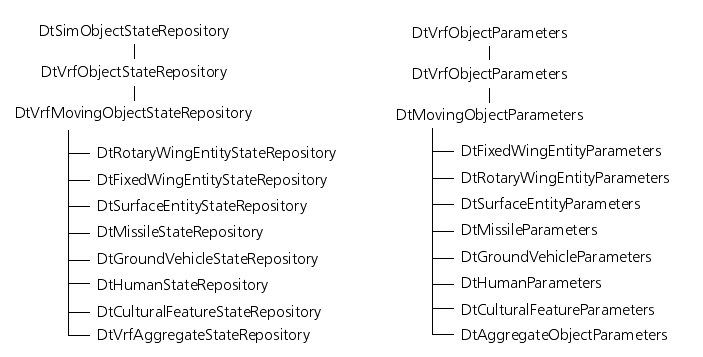
DtVrfObjectParameters derives from DtReaderWriter, allowing instances of a parameter class to be read or written. The parameter classes also use the DtReaderWriter capability to indicate whether or not a value was specified for a given member.
DtVrfObjectParameters provides the necessary infrastructure for working with the parameter factory. As with most classes that use factories, the type() member function returns the class type string, as found in paramTypes.h.
Each parameter class provides accessors and mutators for the parameters it supports, as well as supplying a default value for each parameter in the constructor.
Parameters have a parameter type string. This string is used by the Object Manager to create the proper parameters class when it creates an entity. The parameter type should match the state repository type specified for the entity. For example, an entity with the state repository type ground-entity-state-repository needs certain parameters that are specific to ground vehicles, and therefore expects parameters that are of parameter type ground-vehicle-param or a type derived from ground-vehicle-param. To see the type string for a state repository class, please see the type() member frunction for that class.
As discussed in 3.3.2 Object Parameters, a database of all the parameter information is maintained within the Simulation Manager. The data is stored in ASCII format, so you can edit it.
Parameters use the factory system, so it is easy to create new parameter types for your models to use. You can create entity-wide parameters, or parameters for specific components. Parameters for components are specified within the component descriptors, which are then used to indicate which components to include with an entity.
Certain components in the system need so much data that it is worth the effort it takes to store the data in a separate file to organize it better. The DtReaderWriterFile (rwFile.h) class, makes this easy to do for any parameters you may need to represent. DtReaderWriterFile lets you give a DtReaderWriter (rdrWritr.h) a derived object and a file name, and it handles opening, reading, writing, and closing the file automatically.
For more information about parameters, please see 3.3.2 Object Parameters and 4.6.1 Entity Parameters.
Member variables for which no value has been specified can inherit values from other instances of parameter classes that are logical ancestors within the parameter class hierarchy. This is done using two virtual member functions, inheritValues() and inheritValuesFromThisType(). If you derive a new parameters class from an existing one, you need to override these two member functions.
The inheritValues() member function takes a pointer to another parameter object that it may inherit from. The type passed is a DtVrfObjectParameters*, although the actual parameter object may be a derived form. Using the parameter argument’s type() member function and its own type() member function, inheritValues() determines if the argument passed in has the same exact type as the type of the object doing the inheriting. If it does, it calls inheritValuesFromThisType(). For the DtSimObjectParameters::inheritValues() member function, if the type does not match, the function returns. For all others, though, if the type does not match, then inheritValues() calls the inheritValues() member function of the type that it derives from, thus passing the parameter argument up the class derivation tree.
All versions of inheritValues() (except for DtSimObjectParameters::inheritValues()) look the same except for the invocation of the base class’s inheritValues() member function.
The following example shows the implementation of inheritValues() for the DtGroundVehicleParameters class, which is derived from DtMovingObjectParameters.
The inheritValuesFromThisType() member function is passed the same parameter argument received by inheritValues(). It checks each member to determine if a value has already been specified for it. If no value has been specified for the member, and a value has been specified for the corresponding member in the parameter argument, the value from the parameter argument’s member is copied to the local member. After this has been done for each member, inheritValuesFromThisType() calls the inheritValuesFromThisType() member function of the class it derives from.
All the derived parameters classes function similarly. Each provides accessors and mutators for all the entity parameters specified for that type. They all override the type() and creator() member functions as required for all classes using the factory scheme. They also override inheritValues() and inheritValuesFromThisType(), as discussed in the previous paragraph.
DtVrfObjectParameters includes the lists of component descriptors specifying the components to be used for an entity type. The inheritValuesFromThisType() member function treats the list as a whole unit. If any component descriptors are found on a list, no inheritance takes place. If no component descriptors are specified on a list, then the parameter object can inherit an ancestor’s entire list.
DtGroundVehicleParameters includes a list of soil factor (DtSoilFactors) entries. Unlike the component descriptors in DtVrfObjectParameters, these individual entries may be inherited from an ancestor, even if other entries already exist. For example, a parameter entry might only specify a soil factor entry for one soil type that it wishes to change. Entries for other soil types from an ancestral entry would be inherited in inheritValuesFromThisType().
[<< The Organization Manager] [Home] [Top of Page] [Process State Repositories >>]