 |
VR-Forces 4.2 Class Documentation
|
|
VR-Forces 4.2 Class Documentation
|
Humans are simulated as platform-level entities in VR-Forces. Examples include friendly and hostile dismounted infantry and civilians./p>
Humans in VR-Forces share certain common elements. A human entity in VR-Forces is always configured with the following:
Because they are members of a military organization, dismounted infantry are also always configured with:
Humans share many of the same systems and simulation components (sensors, controllers, and actuators). To examine the systems typically configured on a human entity, we'll look at a specific instance of a human, the DI M4 entity. Differences arise between the various types of entities as a function of which particular sub-systems are configured, and the parameter values it is configured with.
For example, a civilian shares the same kinematics model as an Mideast combatant, but it does not include a weapon system.
Defined in parameter files Human.ope and DI_M4.entity.
The figure below shows which systems and simulation components are configured as part of a friendly dismounted infantry entity. The boxes (nodes) represent either a system of components (DtComponentSystem) or indivdiual DtSimComponent classes. The edges connecting the boxes indicate port or port group connections between components. Information such as detected targets and control inputs are exchanged between components through ports.
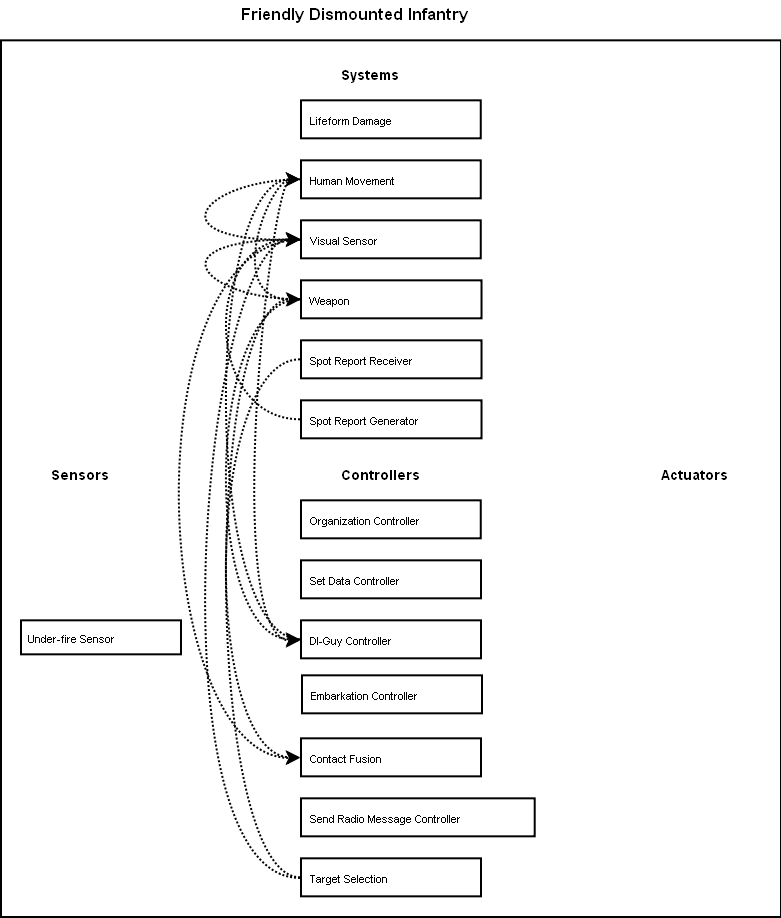
Major sub-elements of an entity's capabilities are organized into systems.
Individual DtSimComponents (not organized as part of a system) that make up the rest of entity.
There are no actuators directly configured as part of this entity.
[<< The Ground Vehicle Entity Behavior Model] [Home] [Top of Page] [The Fixed-wing Entity Behavior Model >>]