 |
VR-Forces 4.8 Class Documentation
|


All Classes Namespaces Files Functions Variables Typedefs Enumerations Enumerator Properties Friends Macros Groups Pages
|
VR-Forces 4.8 Class Documentation
|
This page describes how fixed-wing entities are represented in VR-Forces.
Fixed-wing entities share certain common elements. A fixed-wing entity in VR-Forces is always configured with the following:
Fixed-wing entities are also typically military aircraft, and therefore are configured with a DtVrfRadio, which enables radio-like communication between entities in the same unit.
To examine the systems typically configured on a fixed-wing entity, we'll look at a specific instance, the F-16A Fighting Falcon entity. It is a representative example that includes many of the common systems and components that make up a fixed-wing entity. Differences arise between the various types of entities as a function of which particular sub-systems are configured on the vehicle, and the parameter values it is configured with.
Defined in parameter files Fixed_Wing_Aircraft.ope and F-16A_Fighting_Falcon.entity.
The figure below shows which systems and simulation components are configured as part of an Attack/Strike Fixed-wing entity. The boxes (nodes) represent either a system of components (DtComponentSystem) or individual DtSimComponent classes. The edges connecting the boxes indicate port or port group connections between components. Data flows between components through these connections.
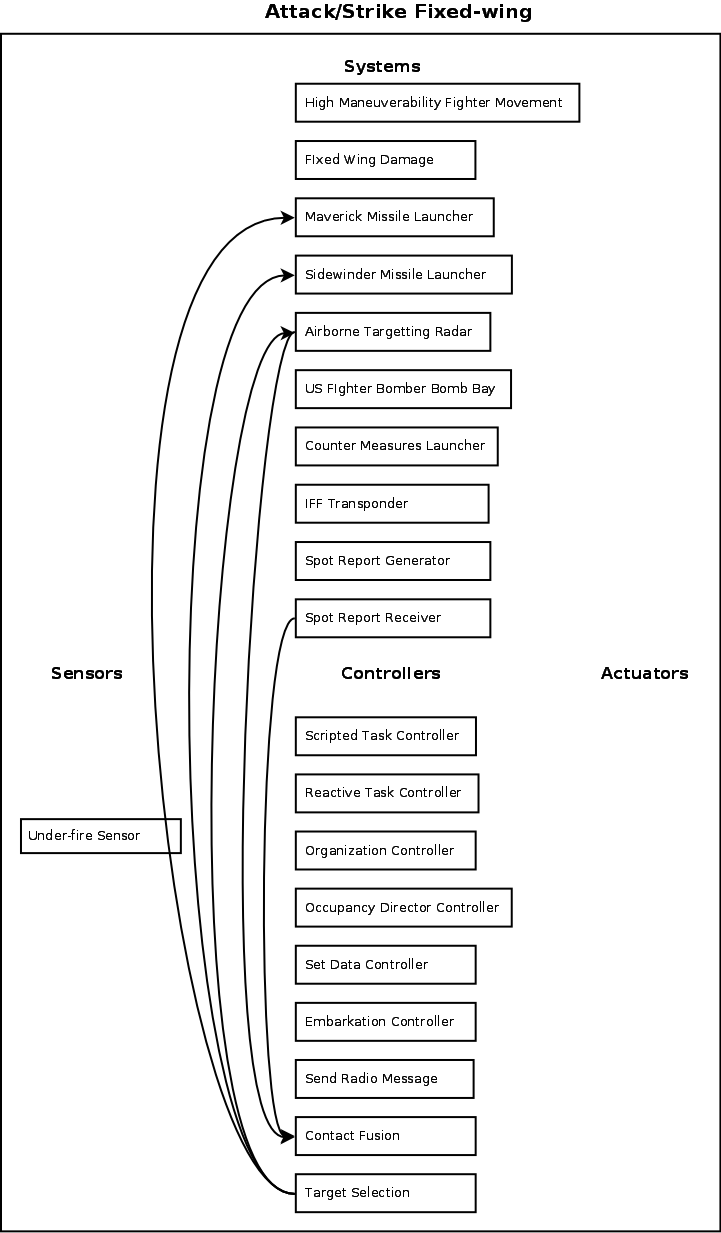
Major sub-elements of an entity's capabilities are organized into systems.
Individual DtSimComponents (not organized as part of a system) that make up the rest of entity:
DtTargetSelectionController – Choose target for weapon system.
There are no actuators configured as part of this entity.
[<< The Human Entity Behavior Model] [Home] [Top of Page] [The Rotary-wing Entity Behavior Model >>]