 |
VR-Forces Developer's Guide
|


All Classes Namespaces Files Functions Variables Typedefs Enumerations Enumerator Properties Friends Macros Groups Pages
|
VR-Forces Developer's Guide
|
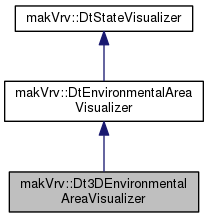
Dt3DEnvironmentalAreaVisualizer display a Area drawn as an overlay Area in the scene without occlusion.
Static Public Member Functions | |
| static const DtStateVisualizer::TypeInfo & | theTypeInfo () |
Protected Member Functions | |
| virtual void | createModelAgents () override |
| virtual void | destroyModelAgents () override |
| virtual void | setModelDefinitionForAgents () override |
| virtual void | updateColors () |
| virtual void | connectToListenerSignals () override |
| virtual void | setInitialValuesFromVisualizerDefinition () override |
| virtual void | implementVisibility (bool visible) override |
 Protected Member Functions inherited from makVrv::DtEnvironmentalAreaVisualizer Protected Member Functions inherited from makVrv::DtEnvironmentalAreaVisualizer | |
| virtual void | setSolid (bool) |
| void | setFriendlyForceColorStyle (vrvTacticalGraphicUtilities::FriendlyForceColorStyle style) |
| Protected Member Functions inherited from makVrv::DtStateVisualizer | |
| virtual void | makeVisible () |
| template<typename T , typename C > | |
| void | connectAndUpdate (boost::signalslib::signal< void(T)> &sig, void(C::*fp)(T), T val) |
Additional Inherited Members | |
| Public Types inherited from makVrv::DtStateVisualizer | |
| enum | Type { AllVisualizerTypes = 0, EntityVisualizerType = 1, EnvironmentalVisualizerType, InteractionVisualizerType, AggregateVisualizerType, IntervisibilityVisualizerType, TacticalSmokeVisualizerType, UserType = 10000 } |
| Protected Types inherited from makVrv::DtStateVisualizer | |
| typedef std::vector < DtVisualizerShowHideContext::VisualizerShowHideContext > | ShowHideContextVector |
| makVrv::Dt3DEnvironmentalAreaVisualizer::Dt3DEnvironmentalAreaVisualizer | ( | DtBaseConnection & | simulation, |
| DtStateListener & | listener, | ||
| DtSceneObjectAgent * | sceneObject, | ||
| DtModelSetId | modelSet | ||
| ) |
CTOR.
|
virtual |
Destructor.
|
delete |
not allowed - default constructor
|
delete |
not allowed - copy constructor
|
delete |
not allowed = equals operator
|
overridevirtual |
Initialize the visualizer.
Reimplemented from makVrv::DtEnvironmentalAreaVisualizer.
|
virtual |
Sets the height of the line separating the back and front face of the area if filled.
|
virtual |
The instance's type info.
Implements makVrv::DtStateVisualizer.
|
static |
This class's type info.
|
virtual |
Sets whether or not to scribe the line (and edges)
|
virtual |
|
virtual |
Sets the height (up extent) of the lines of the area.
|
virtual |
Sets the color of the scribe line.
|
virtual |
Sets the color to used for the scribe when the mode is selected.
|
overridevirtual |
Set outside color This also sets myScribeColor for VRF, to have a different 'fill' color to scribe color, call setScribeColor after this.
Reimplemented from makVrv::DtEnvironmentalAreaVisualizer.
|
virtual |
Sets the values of the extents of the line. Extents of the line are different than the width or height in that in setting the width or height those are centered around the points. The extents work from the point and move in the direction of the extent in topographic space. For example, if you imagine a straight line, the up extent moves straight up from that line, the down extent straight down, left to the left and right to the right. As the line rotates and orients the extents orient and rotate with that line.
|
virtual |
Sets the values of the extents of the line. Extents of the line are different than the width or height in that in setting the width or height those are centered around the points. The extents work from the point and move in the direction of the extent in topographic space. For example, if you imagine a straight line, the up extent moves straight up from that line, the down extent straight down, left to the left and right to the right. As the line rotates and orients the extents orient and rotate with that line.
|
virtual |
Sets the values of the extents of the line. Extents of the line are different than the width or height in that in setting the width or height those are centered around the points. The extents work from the point and move in the direction of the extent in topographic space. For example, if you imagine a straight line, the up extent moves straight up from that line, the down extent straight down, left to the left and right to the right. As the line rotates and orients the extents orient and rotate with that line.
|
virtual |
Sets the values of the extents of the line. Extents of the line are different than the width or height in that in setting the width or height those are centered around the points. The extents work from the point and move in the direction of the extent in topographic space. For example, if you imagine a straight line, the up extent moves straight up from that line, the down extent straight down, left to the left and right to the right. As the line rotates and orients the extents orient and rotate with that line.
|
virtual |
Sets the values of the extents of the line. Extents of the line are different than the width or height in that in setting the width or height those are centered around the points. The extents work from the point and move in the direction of the extent in topographic space. For example, if you imagine a straight line, the up extent moves straight up from that line, the down extent straight down, left to the left and right to the right. As the line rotates and orients the extents orient and rotate with that line.
|
virtual |
Sets the values of the extents of the line. Extents of the line are different than the width or height in that in setting the width or height those are centered around the points. The extents work from the point and move in the direction of the extent in topographic space. For example, if you imagine a straight line, the up extent moves straight up from that line, the down extent straight down, left to the left and right to the right. As the line rotates and orients the extents orient and rotate with that line.
|
virtual |
Sets the values of the extents of the line. Extents of the line are different than the width or height in that in setting the width or height those are centered around the points. The extents work from the point and move in the direction of the extent in topographic space. For example, if you imagine a straight line, the up extent moves straight up from that line, the down extent straight down, left to the left and right to the right. As the line rotates and orients the extents orient and rotate with that line.
|
virtual |
Sets the values of the extents of the line. Extents of the line are different than the width or height in that in setting the width or height those are centered around the points. The extents work from the point and move in the direction of the extent in topographic space. For example, if you imagine a straight line, the up extent moves straight up from that line, the down extent straight down, left to the left and right to the right. As the line rotates and orients the extents orient and rotate with that line.
|
overrideprotectedvirtual |
Create a DtExtrudedPolygonModelAgent.
Reimplemented from makVrv::DtEnvironmentalAreaVisualizer.
|
overrideprotectedvirtual |
Destroys any model agents currently created.
Reimplemented from makVrv::DtEnvironmentalAreaVisualizer.
|
overrideprotectedvirtual |
Sets model definitions for agents & initializes the model.
Reimplemented from makVrv::DtEnvironmentalAreaVisualizer.
|
protectedvirtual |
Update the colors.
Reimplemented from makVrv::DtEnvironmentalAreaVisualizer.
|
overrideprotectedvirtual |
Connect the visualizer to the listeners signals Called by DtStateVisualizer::initialize()
Reimplemented from makVrv::DtEnvironmentalAreaVisualizer.
|
overrideprotectedvirtual |
Sets member variables from the visualizer definition if they exist Should not call this directly. Called by DtStateVisualizer::initialize.
Reimplemented from makVrv::DtEnvironmentalAreaVisualizer.
|
overrideprotectedvirtual |
Override to check whether deleteTacticalGraphicsOnHide is true on the listener. If !deleteTacticalGraphicsOnHide this method will call setVisible(false) on myExtrudedAreaModel, rather than calling destroyModelAgents. This improves show hide performance for the DtOsgExtruded Model as it expensive to destroy and recreate.
Reimplemented from makVrv::DtStateVisualizer.
|
protected |
|
protected |
|
protected |
|
protected |
|
protected |
|
protected |
|
protected |
|
protected |
|
protected |
|
protected |
|
protected |
|
protected |